Vietnamese wedding traditions for first-time guests in 2026
VND 500,000-1,000,000 per guest is a practical starting range for many city weddings in 2026. Adjust it for your relationship, the venue and what you can afford.
Written by Tụi mình mê biểnUpdated
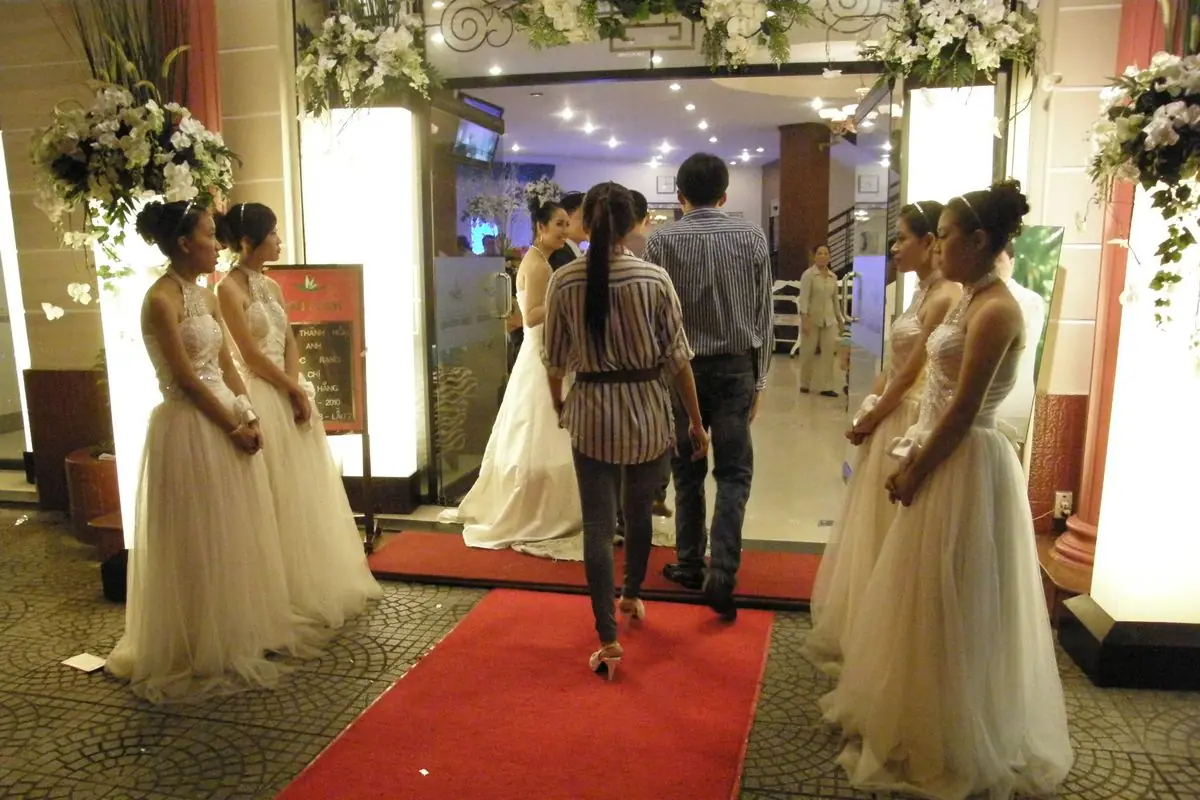
Photo: 兵庫胡志明倶楽部
A colleague invites you to a wedding reception in Ho Chi Minh City, and the card says 6:00 p.m. You have three questions: Is VND 500,000 enough, can you wear a black dress, and should you actually arrive at six? For many ordinary city weddings, VND 500,000-1,000,000 per person is a reasonable reference range, but the right gift depends on how well you know the couple, the venue and your budget. The invitation and the family's plans matter just as much as the money.
How much money should you give at a Vietnamese wedding in 2026?
Cash in an envelope remains the most familiar wedding gift in Vietnam. Friends and colleagues tend to give a round amount in Vietnamese dong, while close relatives may give considerably more or present gold or another family gift. There is no official wedding-gift amount and no national fixed rate. Visitors from abroad are not expected to pay a special foreigner price.
For a single guest at a regular urban reception, VND 500,000 is an accessible starting figure. VND 1 million often makes sense for a good friend or a more formal invitation, and VND 2 million or more may be suitable for someone very close to you. At a small wedding in a rural community, VND 300,000-500,000 can be more typical for acquaintances. These are planning ranges; each family follows its own rule rather than a survey-based national average.
| Your relationship with the couple | Suggested reference for one guest in 2026 | What changes the decision |
|---|---|---|
| Acquaintance or distant friend | VND 300,000-500,000 | Venue, local practice and whether you attend |
| Colleague or casual friend | VND 500,000-700,000 | Your workplace group's usual approach |
| Good friend | VND 700,000-1,000,000 | How close you are and your budget |
| Very close friend | VND 1,000,000-2,000,000 | Personal connection matters more than banquet cost |
| Close relative | Often VND 1,000,000 or much more | Family conventions, age, role and any separate gift |
These figures are per guest attending alone. They are not cumulative tiers. A close relative may take part in a family gift that cannot sensibly be compared with a colleague's envelope. Nor does the table mean anyone should stretch beyond what they can afford.
A useful real-world comparison is a wedding banquet costing VND 7 million for ten guests. That makes VND 700,000 per seat before considering other expenses, yet an invited colleague can still wonder whether to give VND 500,000 or VND 1 million. That is the central tension: banquet prices can be high, but guests have their own rent, travel costs and other commitments. Being invited does not make you responsible for settling the hosts' catering bill.
Does a restaurant, hotel or countryside wedding change the amount?
At a family-home or countryside wedding, the food may be prepared by relatives, a local caterer or a rented cooking team under a marquee. Costs and local giving practices vary widely. An acquaintance might choose VND 300,000-500,000, but someone who grew up in the same village could know a different norm. Ask a local friend rather than assuming the amounts used in central Hanoi apply everywhere.
At a standard wedding restaurant, VND 500,000-1,000,000 is a workable range for many friends and colleagues, with the higher end more comfortable for closer friendships. A colleague's modest envelope is still respectful in an expensive-looking hall. You are giving a wedding present, not buying a meal.
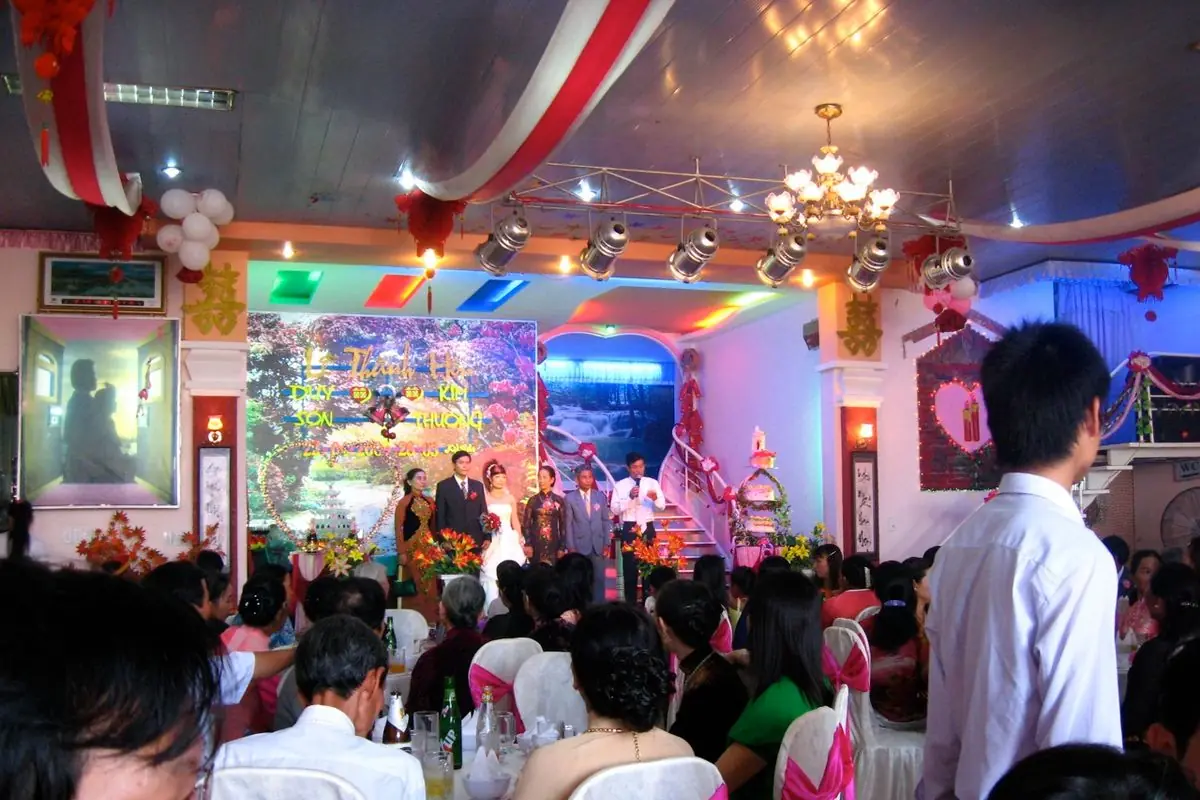
Photo: Dragfyre
At an upscale hotel, some guests choose to increase their gift, especially if the couple is close to them. For context, wedding packages at Eastin Grand Hotel Saigon start from VND 5.9 million++ per table, with higher-priced packages above that. The “++” indicates additional charges. This is one hotel's package price, and it sets no minimum for your gift.
The distinction is even clearer around Nha Trang. A lunch wedding hosted by a family outside the city is a very different event from a ceremony at a seaside resort on Hòn Tre Island. Travel logistics, packages, decorations and venue costs change, but none of that creates a compulsory cash amount for guests. A destination wedding raises practical questions: ask what has been arranged for transport or accommodation, and do not assume your envelope should cover the entire experience.
What if you are attending as a couple?
If both your names appear on the invitation, or the couple has confirmed your partner is welcome, budget for two seats. For a regular restaurant reception, VND 1 million-1.5 million jointly may be a reasonable starting point for two casual friends or colleagues; more may be appropriate for a closer relationship. You can place the combined amount in one envelope with both your names written on it. There is no need to carry two separate envelopes unless you prefer to give individually.
Do not treat a wedding invitation as an automatic plus-one. An invitation that only names you is your cue to ask: “Would it be all right if my partner came with me, or have you already finalized the tables?” Hosts often reserve seating and food in advance. An unexpected additional guest can create more difficulty than an envelope that is a little smaller than expected.
Children are another reason to check. A toddler sitting on a parent's lap is different from an older child needing a full place at the table. Ask whether children are included and let the family know how many people will attend. There is no universal Vietnamese wedding rule that says a child costs half an adult's gift.
Do you still send money if you cannot attend?
A close friend, or someone who attended your wedding, will appreciate a bank transfer or an envelope sent through a mutual friend. Someone you barely know may be happy with a warm message. Most useful of all, decline before the final guest count, well before the event is underway.
How to decide on an amount without overthinking it
Consider your relationship first, your available money second and the venue third. This order prevents the room's chandeliers or a colleague's comments from pushing you toward an amount you did not plan to spend. A wedding may involve hundreds of people with very different incomes. A guest should not need to borrow money or cut essential living expenses to attend.
Imagine three invitations. The first comes from a colleague you have worked with for six months, for a restaurant dinner in Hanoi. VND 500,000-700,000 is worth considering. The second is a university friend you have stayed close to for ten years, getting married in Nha Trang. You might start at VND 1 million and go higher if you can. The third is a cousin of your Vietnamese partner, holding a ceremony in their hometown. The sensible answer is to ask your partner whether you are going as a couple, part of the extended family or two separate guests.
You may hear that Vietnamese families record wedding gifts and later reciprocate when the giver's family has a wedding. That practice exists in many families, but it is not a legally enforceable debt and should not become an exact accounting exercise. A list can help families remember who came and what they gave. It does not mean a young employee must match the envelope of a senior manager.
Within a group of colleagues, asking what the others plan to give is normal. It can prevent confusion, particularly when some colleagues are attending alone and others as couples. However, a group amount is still a group preference. You can choose a different figure privately if you need to.
One more point for international visitors: avoid converting everything into your home currency and deciding that a sum “looks cheap.” VND 500,000 may be a modest dinner bill in one country and a meaningful expense for a local worker. The social meaning of a wedding gift comes from the relationship and context.
How the wedding envelope works
You will usually see a reception desk or welcome table near the entrance. There may be a decorated box labelled for the bride's or groom's side, a guestbook, a seating chart and someone helping guests. This is where most people deposit their envelopes before entering the banquet room.
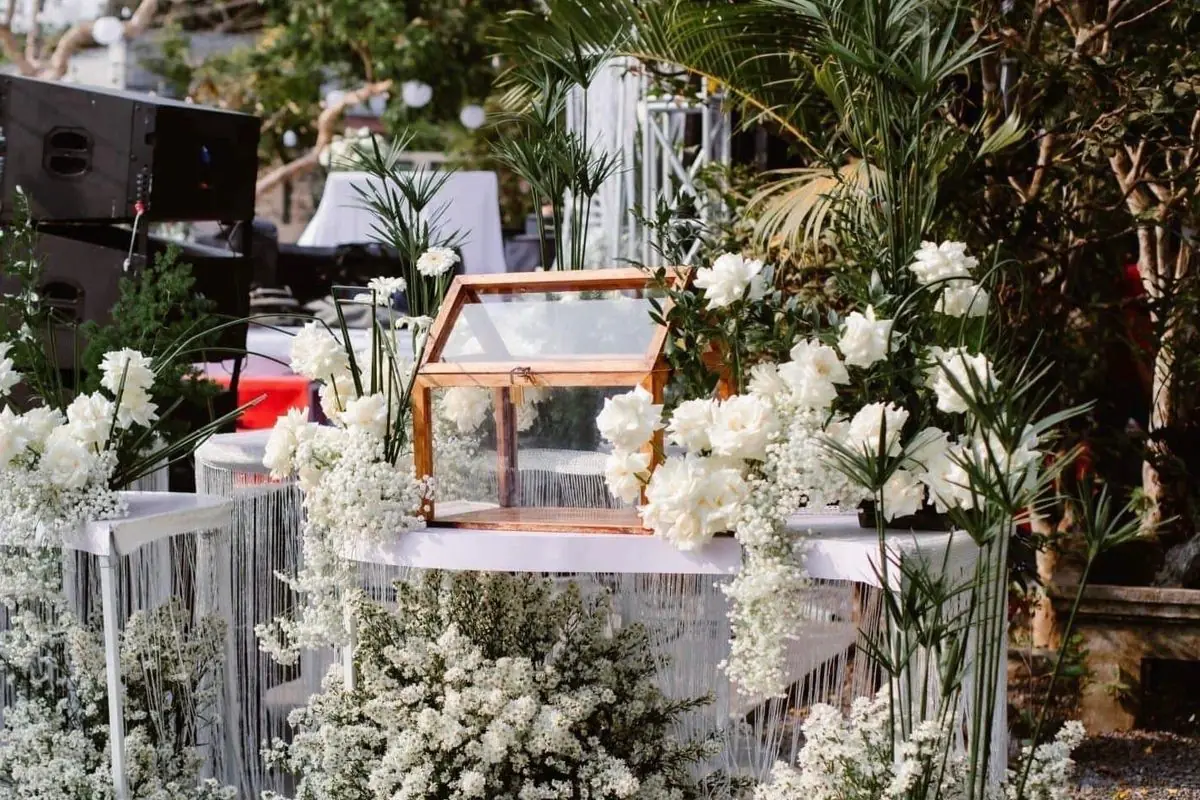
Photo: Hoa Hạnh Phúc
Use a clean envelope and write your name clearly on the outside. A wedding invitation sometimes comes with an envelope that can be reused, but a plain envelope is also fine. Red is associated with celebration, yet a red envelope is not mandatory for a wedding in Vietnam. An elaborate card or an expensive gift bag adds nothing here.
Some weddings have two separate gift boxes, one for the bride's family and one for the groom's. The receptionist or a family member can point you to the right one: “I am the bride's friend. Which box should I use?” At smaller home weddings, there may be no visible box; ask the person welcoming guests where you should leave your gift.
There is usually no need to hand cash directly to the couple. They may be taking photographs, greeting relatives or preparing for the ceremony. Do not leave an envelope on a dining table or tuck it into a floral display, where it could be misplaced.
Fresh, neat banknotes are nice if they are easy to obtain, but perfect new notes and lucky-number sequences are not required. A normal round figure is clearer than trying to decode every symbolic number. Most important, keep the envelope secure until you give it to the intended person or place it in the box.
What to wear to a Vietnamese wedding
The safest formula is smart, comfortable clothing suited to the venue. Check the invitation for a dress code before choosing colors. Some couples request a particular palette; others host a straightforward lunch reception where guests wear the same smart clothes they would choose for a family celebration.
What women can wear
A midi dress, knee-length or longer dress, jumpsuit or a blouse with tailored trousers usually works for a restaurant wedding. Pastel blue, dusty pink, lavender, navy, soft green and other understated colors are easy choices when there is no specified theme. Choose something you can sit and eat in comfortably. You may be getting in and out of cars, walking across a courtyard or standing for group photographs.
A Vietnamese áo dài is also appropriate for a guest. It works especially well for family ceremonies, engagement celebrations and traditional receptions. Choose a simpler design than the bride's, and wear it with trousers as intended. First-time wearers do better asking the shop for a comfortable fit than choosing a very tight outfit because it looks elegant in a photograph.
At a home ceremony, practical shoes matter. A narrow street, tiled step or temporary marquee is not the same as a hotel lobby. Low heels or smart flats can be easier than stilettos. For a beach reception in Nha Trang, follow any guidance from the hosts about sand-friendly shoes or outdoor conditions.
What men can wear
A collared shirt, chinos or dress trousers, and clean leather or smart casual shoes will be appropriate for many receptions. A blazer adds formality at hotels; a full suit is useful if the invitation calls for formal dress. In hot coastal cities, choose breathable fabrics rather than a heavy outfit that becomes uncomfortable before dinner starts.
Shorts, beach sandals and gym clothing are best left out unless the couple has explicitly planned an informal beach event. A white shirt with dark trousers is entirely ordinary for male guests. Foreign visitors are not expected to rent traditional clothes, although a well-fitting áo dài can be a respectful choice if the couple has suggested one.
Can you wear white, black or red?
White: The main issue is looking like the bride. Avoid an all-white lace dress or anything that resembles a wedding gown. White accessories and men's white shirts are generally fine. Some Vietnamese brides wear white Western-style gowns at the banquet and a different color during the family ceremony.
Black: An entirely black outfit may feel too somber for a more traditional family, as black can carry mourning associations. However, modern black dresses and black suits are worn at urban weddings too. There is no universal prohibition. A colored shirt, scarf or accessories will soften an all-black look.
Red: Red is an auspicious wedding color, but it may also be the bride's áo dài color at the engagement or ancestral ceremony. Avoid an elaborate red áo dài that competes with the bride's outfit, especially if you will be standing close to the family for photographs. A simple red dress at an evening reception is a different situation and may be perfectly acceptable.
What time should you arrive at a Vietnamese wedding?
Read the time on the invitation carefully. Some cards show đón khách (guest reception or arrival) and khai tiệc or nhập tiệc (start of the banquet). For example, “Đón khách: 17:30 - Khai tiệc: 18:30” invites you to arrive during the welcome period, ideally about 10-20 minutes before the program begins. A card showing just “18:00” leaves room for doubt, so ask whether that is the welcome time or the ceremony start.
It is true that some large banquets in Vietnam start later than the printed arrival time as guests trickle in. This is not permission to turn up an hour late to every wedding. A family altar ceremony, church service or tightly scheduled hotel event may begin promptly, and late arrivals can interrupt an important moment.
For planning purposes, a lunchtime wedding may receive guests around 10:30 or 11:00 a.m., while an evening banquet may list arrival times between roughly 5:30 and 7:00 p.m. These are examples rather than national standards. Your particular invitation is the authority. If the host has specified a shuttle bus, boat or gathering point, follow that timing even if it feels earlier than necessary.
This matters in Nha Trang, where wedding venues can be near Trần Phú Street, outside the city or on an island. Driving to a hotel in the city center is not the same as meeting a transfer for a resort on Hòn Tre. For any destination wedding, confirm the departure point, return arrangements and whether transport is included in your invitation.
At the entrance, find the welcome table, sign the guestbook if there is one, leave your envelope and ask about your assigned table. You may be invited to take a photograph with the couple at the backdrop. There is no need to wait in a long queue while they are busy; you may have another chance to greet them when they visit the tables.
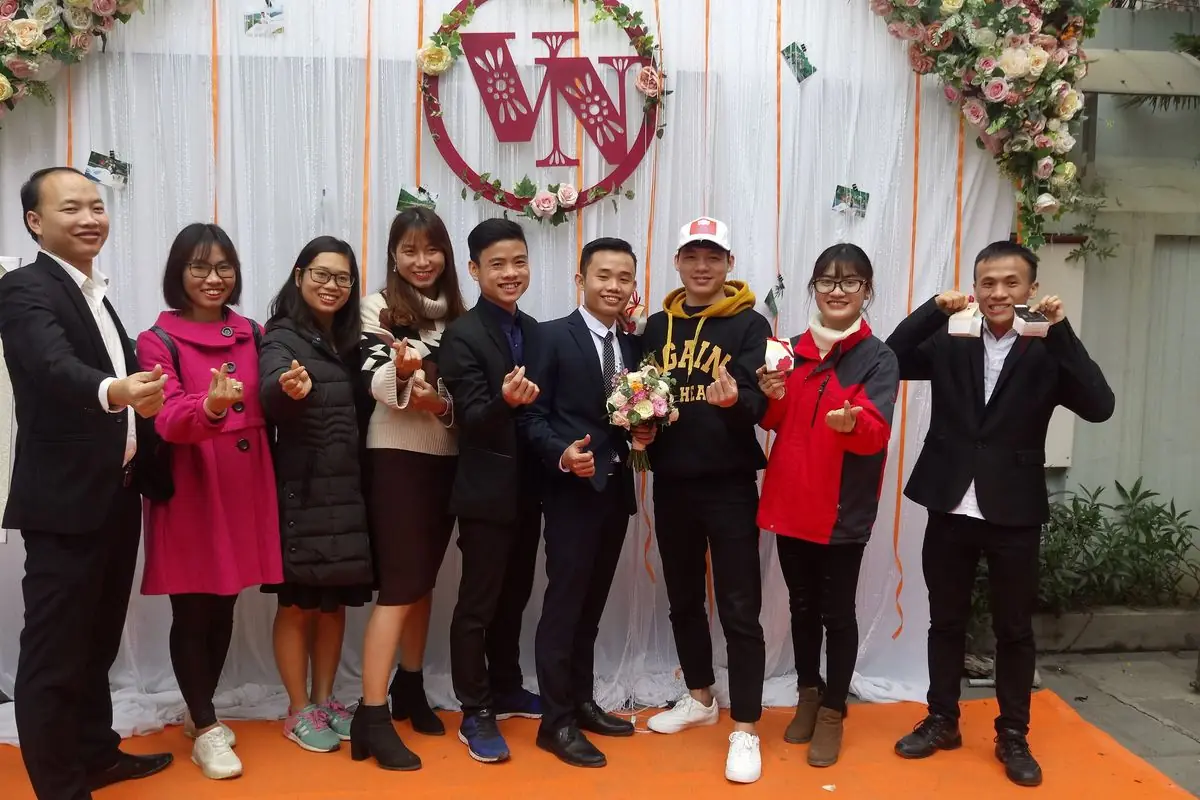
Photo: Litequang
Vietnamese wedding customs: what happens at each ceremony?
The term “Vietnamese wedding” can describe several separate events. Understanding the Vietnamese words on the invitation helps you avoid turning up at the wrong house or assuming every guest needs to attend everything. The four most useful distinctions are dạm ngõ, lễ ăn hỏi, rước dâu and tiệc cưới.
Dạm ngõ
The formal family introduction
Dạm ngõ is traditionally a meeting between the two families to discuss the couple's marriage and the next steps. It is generally small and family-centered. An ordinary colleague will not usually be invited. If your Vietnamese partner asks you to attend a dạm ngõ involving relatives, ask what role you have and whether the family expects you to bring anything.
There is no standard guest envelope for a casual observer at this kind of meeting. Gifts and ceremonial offerings are normally coordinated by the families. Do not buy a tray of presents or a large household gift because a website describes it as traditional; it may not fit the family's arrangements.
Lễ ăn hỏi or đám hỏi
The engagement ceremony
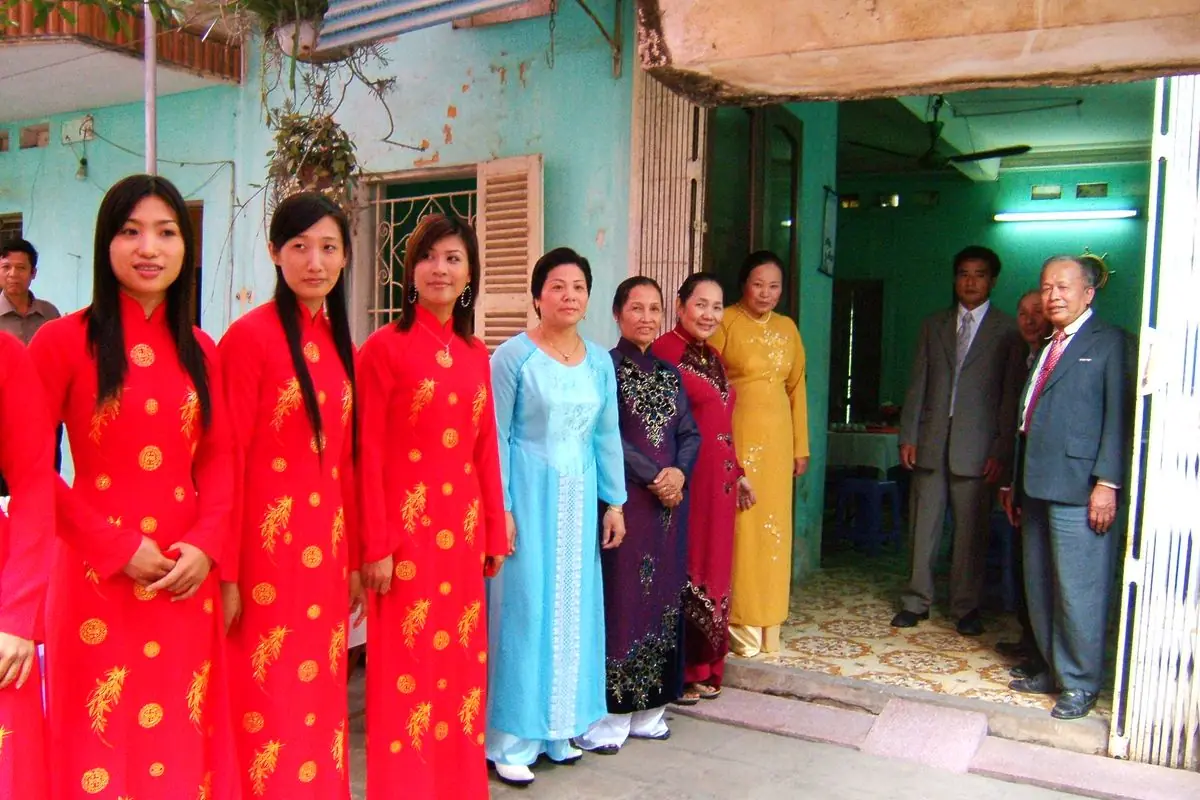
Photo: Khương Việt Hà
During the lễ ăn hỏi, representatives of the groom's family bring formal gifts to the bride's family. These can include betel and areca nuts, tea, wine, cakes, fruit and other items agreed upon beforehand. The gifts are commonly arranged in decorated trays, sometimes covered with red cloth. Family representatives speak, the offerings are received, and the couple may perform rites before the ancestral altar.
Joining the bê tráp team carrying the trays makes you a participant, not just a spectator. You may have to meet the group early, wear a matching outfit and stand in a specific place. Confirm the meeting time and transport, and follow the person organizing the procession. Do not stop to take selfies while carrying a tray or switch trays without being asked.
Most ordinary friends attending the wedding banquet skip the engagement ceremony. Nor must they automatically give two separate cash gifts. If you have been invited only to the engagement, ask the family whether a small envelope, another present or simply your presence is appropriate.
Rước dâu
The bridal procession and ancestral rites
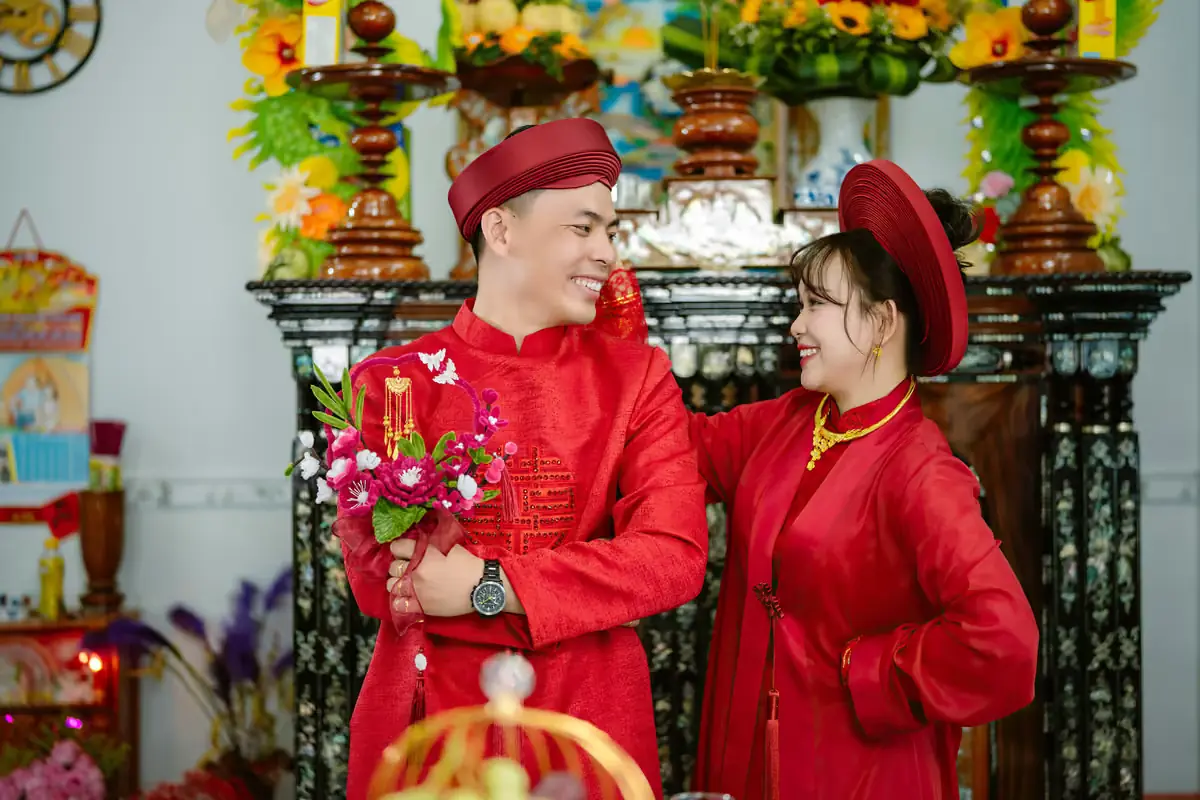
Photo: Phẩm Bùi
Rước dâu refers to the groom's party going to receive the bride, typically at her family's home, before accompanying her to the groom's home or the next planned venue. The family may first perform a xin dâu request and later hold rites honoring ancestors. The bride and groom may offer incense, tea or wine to parents and elders and receive their blessings. Some families repeat related ceremonies at both homes.
These rites can take place early in the morning at a time chosen by the family. A guest should arrive at the specified time rather than assuming the wedding begins when dinner begins. Family-home ceremonies may be crowded, so give elders, tray carriers and the official photographer enough room.
Stay clear of the ancestral altar unless someone invites you forward. Do not step between the couple and their parents during a blessing, move offerings or use flash photography directly in front of people performing rites. Some families ask guests to remove their shoes; follow the household's practice.
Some couples also have a religious ceremony, such as a service in a church. In that case, take the start time seriously, dress with the venue in mind and follow the family's guidance about where visitors may sit or stand. Respect does not require taking part in unfamiliar religious acts.
Tiệc cưới
The wedding banquet or reception
This is the part that most colleagues and friends are invited to. It may be a catered meal at home, a restaurant banquet, a hotel reception or an outdoor party. Guests leave envelopes, have photographs taken and sit at round tables. An MC may introduce the families and the newlyweds before speeches, a toast, a cake-cutting or other short stage moments.
A typical restaurant banquet serves several shared courses. Food comes to the table in sequence, and the bride and groom may visit each table to thank guests and take group photographs. There may be beer, soft drinks, music and enthusiastic toasts. You can decline alcohol and raise a glass of water instead. Being a good guest does not require drinking more than you want.
Many receptions last around two to three hours, though actual schedules vary. At some home weddings, neighbors and relatives come in waves throughout the day. At a tightly organized hotel banquet, the program can be shorter and more fixed. Ordinary guests can often leave after the meal and their congratulations, but close family members and people helping with the wedding may have additional duties.
Do wedding traditions differ between northern, central and southern Vietnam?
Yes, but the differences are not a strict three-part rulebook. Families move between regions, marry across regional backgrounds and adapt ceremonies to time, distance, religion and budget. A northern family in Ho Chi Minh City may combine customs, while two families from neighboring towns can still have different expectations.
Northern Vietnam: In places such as Hanoi and Hai Phong, families often distinguish the formal introduction, engagement and bridal procession quite clearly. Engagement gifts are arranged in decorated tráp, and an odd number of trays, such as five, seven or nine, is associated with some northern practices. Traditional family ceremonies may be more carefully sequenced than the eventual banquet. For an invited guest, the practical point is to check whether you are expected at the bride's home, the groom's home or simply the restaurant.
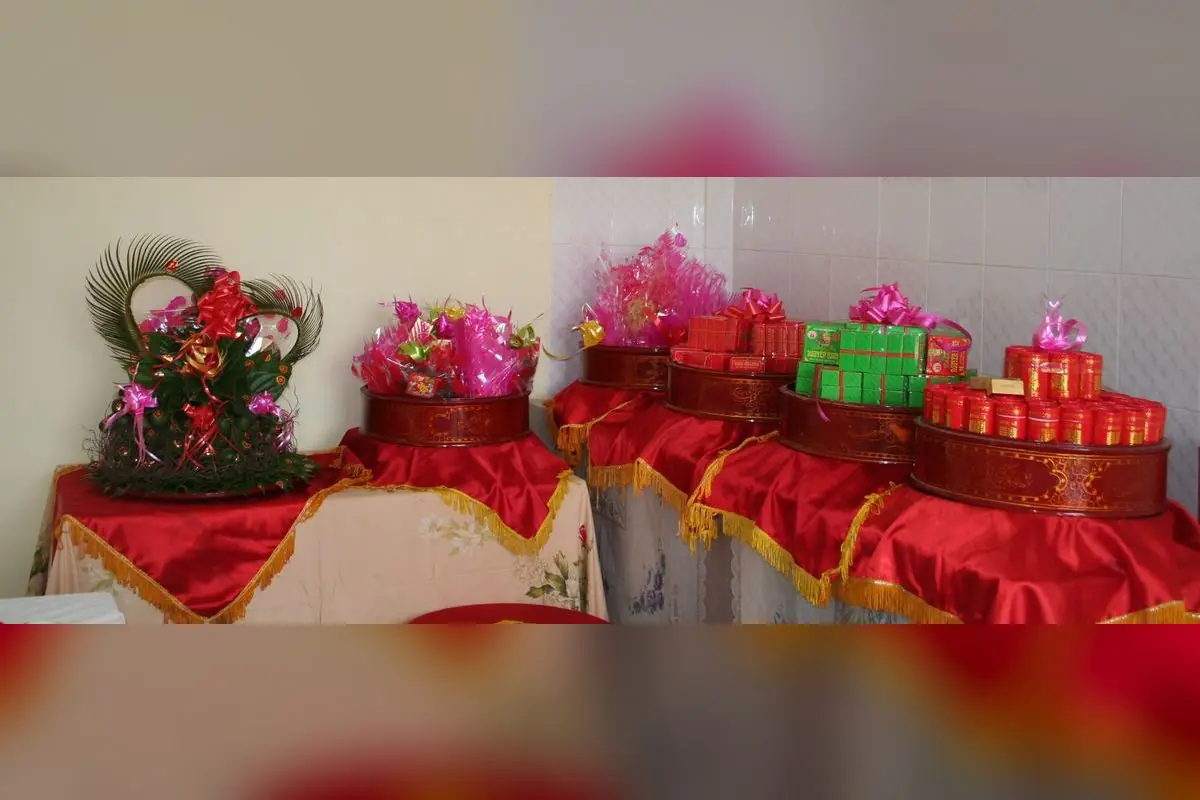
Photo: Viethavvh at vi.wikipedia
Central Vietnam: Customs vary from Huế and Da Nang to Khánh Hòa. Ancestral rites and family offerings can be important, and some families arrange a compact program while others separate ceremonies over different days. Do not assume a wedding in Nha Trang follows every detail of a wedding in Huế. Get the exact venue name and street address before traveling for the event, and ask whether the host has arranged a shuttle or separate transport for the ceremony.
Southern Vietnam: In some families, the engagement and bridal procession take place on the same day, especially when the two homes are far apart. An even number of gift trays is found in some southern traditions. The lên đèn or thượng đăng rite, involving a pair of ceremonial candles at the ancestral altar, is a recognized feature of traditional southern weddings. Modern families may adapt or omit parts of it. In the cities, evening banquets are common, while weddings in provincial communities may include daytime meals under a marquee.
“We have the family ceremony in the morning, then dinner at the hotel” describes two different parts of the wedding. Attend what you were invited to. A dinner invitation is for dinner; the morning visit to the bride's family home is for the guests invited to it.
Photography, greetings and table etiquette
A Vietnamese wedding is often a very photogenic event, but some moments are private family rituals rather than a public performance. At the welcome backdrop, a quick photo with the couple is usually welcome. During the family ceremony, keep clear of the procession and the official photographer's view. Avoid stepping directly in front of the altar, rearranging ceremonial items or leaning over a relative to get a better shot.
Before photographing an individual elder, child or private family exchange, ask if it is all right. The same applies to posting photos. Some couples love immediate Instagram stories; others prefer to announce their marriage themselves first. Check before sharing images of the couple from a private ceremony, and never post an envelope, a gift ledger or payment details online.
Skip the long speech in Vietnamese: “Chúc mừng hạnh phúc” is an easy congratulatory phrase. A smile and a greeting to the couple's parents are also enough. Vietnamese family pronouns are tricky, so let your Vietnamese friend introduce you instead of guessing how to address every elder.
At the table, follow the seating arrangement if one has been made. Round tables usually have shared dishes, small bowls and chopsticks. Wait until the food is served and take a normal portion so others can share. The couple may stop by for a photograph or a toast; put down your chopsticks for a moment and make room. Nobody expects you to abandon your seat every time another table starts cheering.
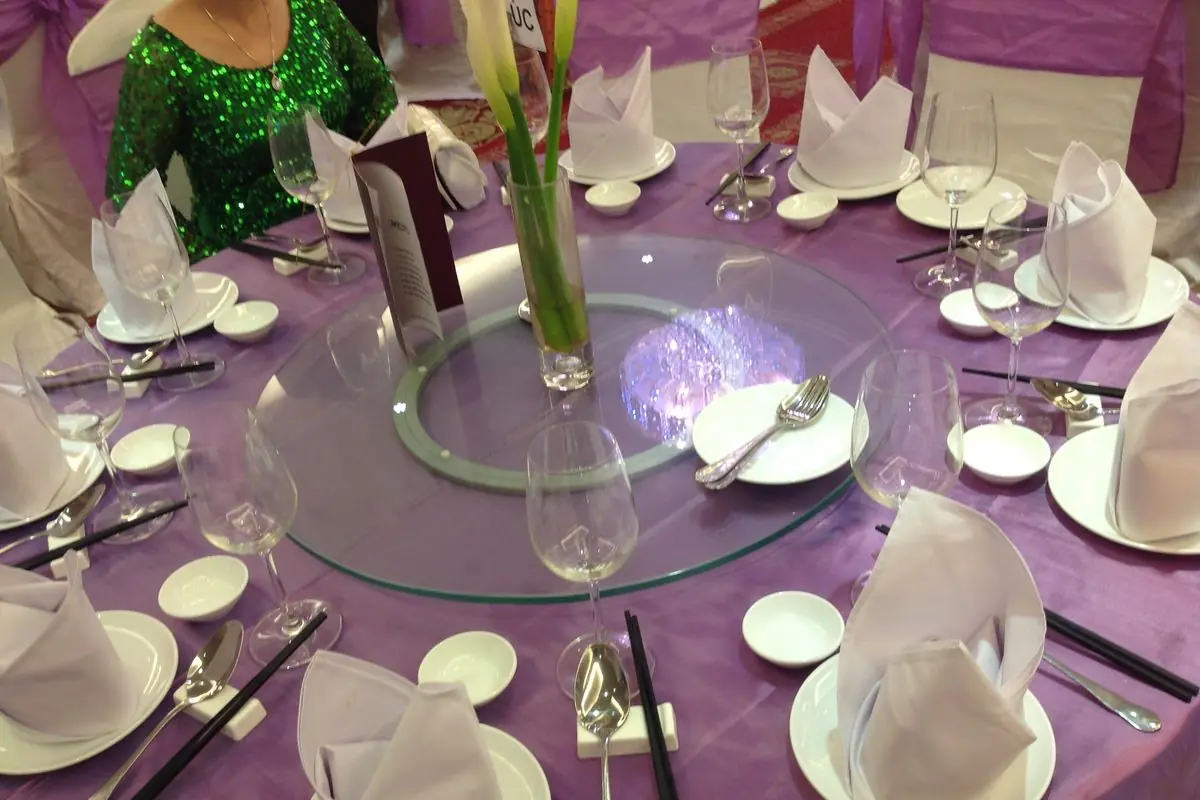
Photo: Phương Huy
Weddings can be loud. Music, an MC and a group shouting “Một, hai, ba, dô!” during a toast are not unusual. You can enjoy the atmosphere without joining every drinking game. If you do drink, arrange a taxi or ride-hailing car rather than driving home.
Can you give a physical present instead of cash?
Yes, especially if the couple has asked for a particular item or shared a wedding registry. However, cash is usually the easiest gift at a wedding in Vietnam. It is portable, simple to record and useful to a couple setting up a household. Bringing a bulky appliance or fragile decoration to a crowded banquet is often less convenient than it sounds.
If you are close to the couple, a personal photograph album, artwork or another thoughtful item can be meaningful, particularly when you know their taste. It can be an alternative if the couple explicitly welcomes non-cash gifts or an addition to the envelope if that fits your budget. Neither approach is compulsory. Do not feel that you must buy a gift and give cash merely because you are a visitor.
A guest flying from overseas should be especially practical. A household appliance may use the wrong plug or voltage, and a large box can be difficult for the couple to transport from the venue. A small card and a named envelope in Vietnamese dong are often easier for everyone.
For multicultural weddings or Vietnamese couples living overseas, gift preferences can be quite different. Some use registries, some prefer contributions to a honeymoon, and some request no gifts. Follow the couple's instructions rather than assuming all Vietnamese families want exactly the same thing.
A first-time guest's plan, from invitation to leaving
- A few days out
Check the invitation
A few days beforehand, check which part of the wedding you have been invited to. Look for the venue's full name and address, the date, any reception and banquet start times, and whether your partner is included. For a card printed in Vietnamese, ask the host to clarify the two or three lines that affect your arrival. There is no need to translate every ceremonial phrase.
- Before the day
Gift, outfit and route
Decide on your gift using the relationship and the examples above. Have the Vietnamese dong ready in a clean envelope with your name on it. Choose your outfit, check the weather if the event is outside, and confirm your route. For a Nha Trang island venue, note the transfer departure and return arrangements instead of relying on the city-center arrival time shown on a map.
- Wedding day
Arrive, give, greet
On the wedding day, aim for the welcome period or the stated start of a ceremony. At the entrance, leave your envelope in the correct box, sign the guestbook if requested, and find your assigned table. Greet the couple when there is an opening, but do not interrupt preparations or the formal entrance. During the meal, follow the hosts' lead for speeches, photographs and toasts.
- Leaving
Congratulate and head home
Before leaving, congratulate the couple if you have not already done so. At a large reception it may be impossible to speak to every family member, and that is fine. Family-party members and tray carriers should ask when their duties finish. Otherwise, heading home after the meal and greetings is usually reasonable.
For a first wedding invitation in Vietnam, you may only need a clearly named envelope with VND 500,000, a smart outfit and a plan to arrive 15 minutes before the banquet begins. The detail that will stay with the couple is more likely to be your face in the table photograph and your congratulations than the exact figure inside the envelope.
FAQ
How much money should I give at a Vietnamese wedding in 2026?
For a guest attending alone, VND 500,000-1,000,000 is a practical reference for many city weddings. A smaller countryside wedding may call for less, while a close friend or relative may receive more. There is no mandatory amount.
What should I wear to a Vietnamese wedding as a foreign guest?
Wear smart clothes suitable for a family celebration. A midi dress, jumpsuit, áo dài, shirt with tailored trousers or suit can all work. Avoid looking like the bride, check the dress code, and choose footwear suited to the venue.
Is it rude to wear black or white at a Vietnamese wedding?
An all-white bridal-looking dress is best avoided. All-black clothing may feel somber in some traditional families, though it is not universally forbidden at modern receptions. A men's white shirt with dark trousers is normally fine.
Should I arrive at the time printed on a Vietnamese wedding invitation?
Yes. Check whether it means đón khách (guest arrival) or khai tiệc (banquet start). If both are printed, arrive during the welcome period and ideally 10-20 minutes before the banquet program. Morning family rites and religious ceremonies may start precisely on time.
Do I need to give cash at both the engagement and the wedding banquet?
Usually not if you are an ordinary guest attending the reception. The engagement gifts are arranged by the families. If you have a special role or are only invited to the engagement, ask the couple what would be appropriate.
Related posts
Guides
Tipping in Vietnam: know when to tip and how much to give
A practical 2026 guide to tipping without overpaying or feeling awkward.
Guides
How to use Vietnam currency: recognize banknotes, exchange money, and pay correctly
A practical guide to Vietnamese money, exchange rates, banknotes, and everyday payments.
Food
18 famous Vietnamese foods to try in all three regions
From pho and cao lau to broken rice, discover 18 Vietnamese dishes worth trying.