Nha Trang sunrise time: when to head to the beach in the morning
To catch the sunrise in Nha Trang, check the daily sunrise time and arrive at the beach about 20-30 minutes early. The 7-day sun calculator helps you choose the right time, viewing direction, and weather conditions before heading out.
Choose your viewing dateWritten by Tụi mình mê biểnUpdated

Photo: Phương Huy
Arrive at Tran Phu Beach at 5:15 AM on November 6, 2026, and you have about 22 minutes before sunrise at 5:37 AM. Reach Tran Phu Bridge at 5:05 PM, and there are only 11 minutes left before the calculated sunset at 5:16 PM, possibly less before the sun disappears behind the western mountains. One spot faces the sea to the east, while the other offers views toward the western side of the city. Getting the time right matters, but so does knowing which direction to look.
Nha Trang sunrise and sunset
Sunrise, sunset, golden hour and blue hour for today and the next 6 days, with a cloud estimate from the forecast
Calculating sun times…
Where to watch
Sunrise
- Tran Phu Beach (Trần Phú): The shore faces east and the sun rises over the sea. Walk along the beach to an open stretch with few trees in the way.
- Hon Chong (Hòn Chồng): A rocky headland north of the center looking out over the bay. The site keeps its own opening hours, so check before planning a dawn visit.
Sunset
- A rooftop: The sun sets behind the mountains to the west, so go high enough to see both mountains and sea, for example Skylight on Tran Phu or Lume Sky Dining & Bar.
- Xom Bong (Xóm Bóng) and Tran Phu bridges: Both cross the Cai (Cái) River; look upstream toward the mountains. Stay on the footpath and do not stop in the traffic lane.
Safety: On an early beach visit, swim only once lifeguards are on duty, inside the buoyed area, and follow the flags. At Hon Chong, stay on the paths and keep well back from spray on the rocks.
Source: Open-Meteo (cloud, rain and visibility forecast; sun times from the NOAA algorithm)
What time is sunrise in Nha Trang today?
On November 6, 2026, sunrise in Nha Trang is approximately 5:37 AM, and sunset is around 5:16 PM, Vietnam time (UTC+7). Daylight lasts about 11 hours and 39 minutes.
These times change slightly from one day to the next. In early November, sunrise gradually gets later, while sunset remains around 5:15-5:16 PM. During the summer months, the days are longer, and sunset occurs later in the evening.
Here are the approximate sunrise and sunset times from November 6 to November 12, 2026.
| Date | Sunrise | Sunset |
|---|---|---|
| Fri, Nov 6 | 5:37 AM | 5:16 PM |
| Sat, Nov 7 | 5:38 AM | 5:16 PM |
| Sun, Nov 8 | 5:38 AM | 5:16 PM |
| Mon, Nov 9 | 5:38 AM | 5:15 PM |
| Tue, Nov 10 | 5:39 AM | 5:15 PM |
| Wed, Nov 11 | 5:39 AM | 5:15 PM |
| Thu, Nov 12 | 5:39 AM | 5:15 PM |
These times are rounded to the nearest minute. The tool shows them in 24-hour format, so 5:16 PM appears as 17:16.
The row of day buttons at the top of the tool displays seven consecutive days, starting with today, so you can check the date of your actual visit.
The calculated sunrise or sunset time is an astronomical one, while the moment you actually see the sun depends on terrain and clouds. In Nha Trang the gap is widest in the evening. Mountains rise to the west of the city, so the sun may disappear behind the landscape before the calculated sunset time. The sky can remain bright afterward, even when the sun itself is no longer visible.
How to use the Nha Trang sunrise and sunset calculator
The calculator runs directly in your browser, with no coordinates to enter, time zones to convert, or astronomical times to work out.
Its solar calculations follow NOAA algorithms using reference coordinates of 12.24° north latitude and 109.19° east longitude. All times are displayed in Vietnam Standard Time (UTC+7).
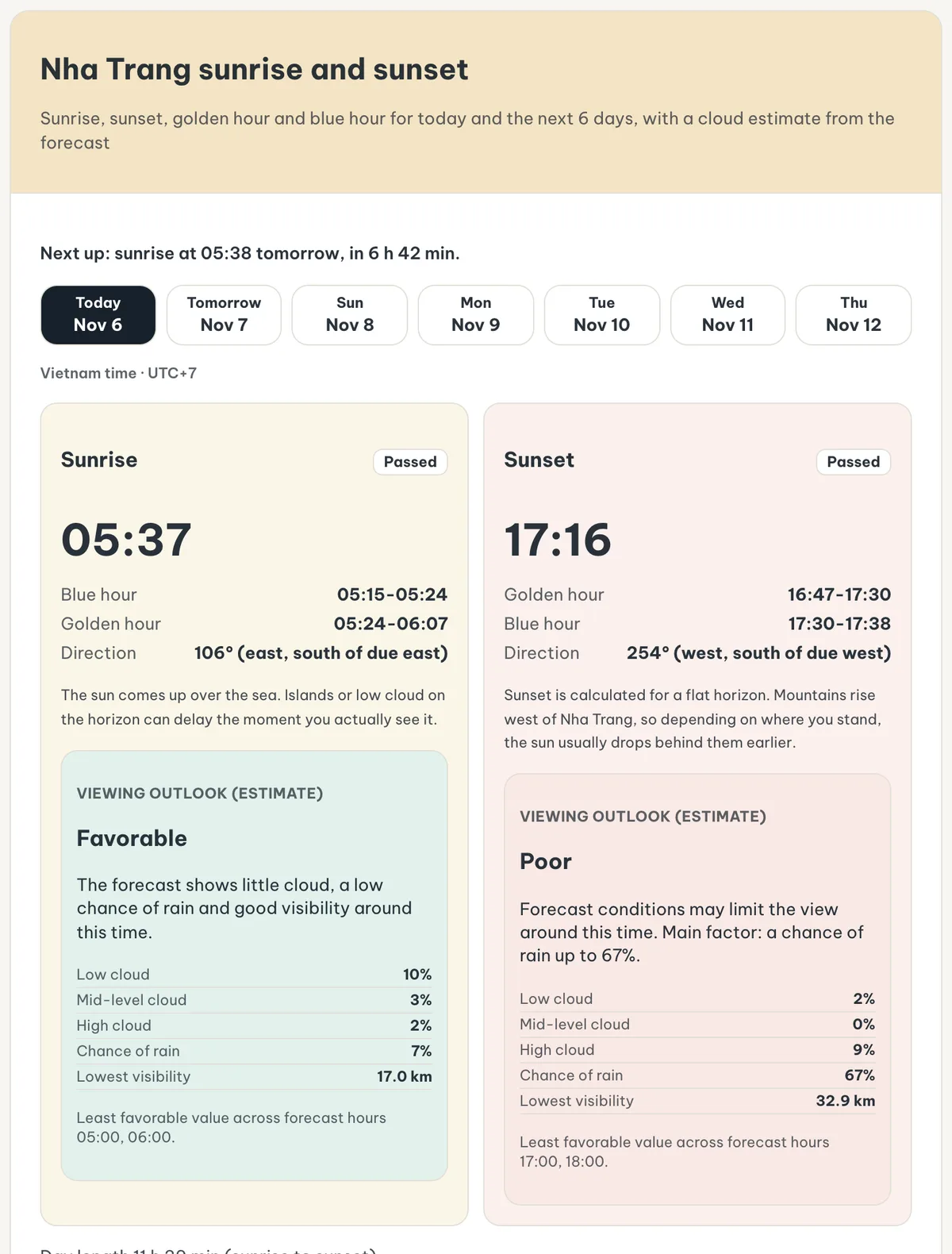
- Step 1
Select the date you want
In the row of day buttons above the two time cards, you will find seven consecutive dates:
- Today: Shows sunrise and sunset times for the current day.
- Tomorrow: Useful for planning an early morning or the following day's itinerary.
- The next five days: Labeled with an abbreviated weekday and, below it, the date, such as Mon and Nov 9.
Select the date you want to check. The information cards below will update to show that day's calculations.
For example, suppose you arrive in Nha Trang on Friday evening, November 6, and want to visit the beach on Saturday morning. Select "Tomorrow", even though Friday's sunrise time is similar.
Over a weekend, compare Saturday and Sunday before deciding which morning to spend at the beach.
The solar information tells you when the sun rises. The viewing outlook gives you an indication of whether clouds, rain, or poor visibility might interfere.
The tool covers only seven consecutive days. It is not a calendar for selecting any date throughout the year, so a visit outside that range has to wait until its date appears among the seven options.
- Step 2
Read the Sunrise and Sunset cards
After choosing a date, two main information cards appear.
Sunrise
This card covers the morning. It shows the calculated sunrise time, direction, blue hour, and golden hour.
Sunset
This card covers the evening. It shows the corresponding information for the period before and after sunset.
Each card holds more than a single time: read the main time first, then check the direction and the surrounding light periods.
If sunrise is at 5:37 AM, that does not mean you should arrive at 5:37 AM. Use that time to work backward and decide when to leave your accommodation.
For a quiet morning at Tran Phu Beach, arriving around 5:10-5:15 AM gives you time to settle in before sunrise. A walk in the early sunlight only needs an arrival closer to sunrise. The astronomical event is the same; what changes is how you want to experience it.
- Step 3
Check the sun's direction
Beside each sunrise and sunset time, the "Direction" line shows the sun's bearing in degrees and a compass description.
The main compass directions are:
Bearing Direction 0° or 360° North 90° East 180° South 270° West Values between these points indicate a direction between two compass points.
For example, on November 6, 2026, the tool shows a sunrise direction of 106° (east, south of due east) and a sunset direction of 254° (west, south of due west).
This information becomes useful when buildings, trees, islands, or mountains stand between you and the horizon.
Central Nha Trang's coastline faces east, making it a natural choice for sunrise. In the evening the sun sets on the landward side of the city, so looking straight out to sea means looking away from it.
At Hon Chong, nearby islands and rock formations may also obstruct certain viewing angles. Check the bearing on the calculator and compare it with the open sky in front of you, since not every spot along the water offers an unobstructed sunrise.
- Step 4
Check the day length
The calculator also shows the length of the day, the interval between calculated sunrise and sunset.
A day lasting 11 hours and 39 minutes could still be cloudy from morning to evening, while a shorter day might have a perfectly clear sunrise. Day length shows how much daylight your itinerary includes, but for deciding whether to head outside specifically to see the sun, the weather forecast near sunrise or sunset is more useful.
What are golden hour and blue hour in Nha Trang?
Both periods appear on the Sunrise and Sunset cards. They help you choose when to arrive, beyond the exact moment the sun crosses the horizon.
Blue hour: when the sun is still below the horizon
The calculator defines blue hour as the period when the sun is between 6° and 4° below the horizon.
In the morning, blue hour occurs before golden hour and sunrise. The sky gradually becomes lighter, but the sun has not appeared.
In the evening, blue hour occurs after golden hour, when the sun has already set and the sky is getting darker.
At Tran Phu Beach, this can be a good time to watch the sky change color, see the outline of clouds over the bay, or enjoy an early walk before the beach becomes busier.
In the evening, areas around Tran Phu Bridge offer a different atmosphere. Streetlights and riverside buildings begin to light up while some natural light remains in the sky.
Blue hour is not a fixed 60 minutes: use the start and end times shown by the calculator for your selected date.
Golden hour: the soft-light period around sunrise and sunset
The calculator defines golden hour as the period when the sun is between 4° below and 6° above the horizon.
In the morning, golden hour begins before sunrise, continues through the moment the sun appears, and ends after it has climbed a little higher.
In the evening, the sequence is reversed. Golden hour begins before sunset and continues briefly after the sun has passed below the horizon.
This is the period to check if you want softer sunlight, low-angle light over the water, or the changing colors of the evening sky.
However, the name only describes the position of the sun. Thick clouds may block the sunlight throughout the entire period, so check the viewing outlook as well as the clock.
Which period should you prioritize?
For an early morning outing, sunrise is straightforward to plan in Nha Trang. Choose a stretch of coastline with an open view toward the east, arrive before sunrise, and watch the sky brighten.
In the evening, start with the afternoon golden-hour period, and add the rooftop's opening time and the time needed to enter and reach the viewing area when you choose one.
Because mountains lie to the west of Nha Trang, waiting until the exact calculated sunset may mean missing the moment when the sun is still visible.
The colors remaining in the sky afterward can still be worth watching, but that is different from seeing the sun itself disappear.
How to read the "Viewing outlook (estimate)" section
Sunrise and sunset times can be calculated in advance. Whether you can actually see the sun depends on the weather.
The calculator therefore includes a section called "Viewing outlook (estimate)".
It uses forecast data from Open-Meteo, including cloud cover at different heights, precipitation probability, and visibility.
The calculator examines forecast hours within 60 minutes before or after sunrise or sunset. It then uses the least favorable conditions in that window to classify the viewing opportunity.
This prevents one relatively clear forecast hour from making the entire period look promising when conditions are poor closer to the event.
There are four possible labels.
Favorable
All 5 thresholds met
The "Favorable" label appears when all the following forecast conditions are satisfied within the evaluation window:
- Low cloud cover below 30%.
- Mid-level cloud cover below 60%.
- High cloud cover below 90%.
- Precipitation probability below 30%.
- Visibility of at least 1 km.
These are encouraging conditions for a sunrise or sunset outing, but they do not guarantee clear skies or attractive colors.
A cloud bank directly along the horizon can still hide the sun.
Weather models also cannot predict the exact shape and position of every small cloud above the sea.
Between two available mornings, prioritize the one marked "Favorable." When both receive the same label, choose whichever fits your travel schedule better.
Mixed
Not Poor, short of Favorable
"Mixed" applies when conditions do not reach the "Poor" thresholds but fail to meet every requirement for "Favorable."
For example, a forecast precipitation probability of 40% stays below the 60% "Poor" threshold, so depending on the other conditions the result may be "Mixed."
You can still go, but there is a greater possibility of cloud obstruction or less distinct sunlight. From a hotel a short walk from Tran Phu Beach, a morning outing takes little effort: you might enjoy the sea, get some fresh air, and return for breakfast.
A long taxi journey, or paying to visit an elevated viewpoint solely for sunset, calls for checking the forecast again closer to departure.
Poor
Any 1 of 3 thresholds
The calculator classifies viewing conditions as "Poor" when at least one of these thresholds is reached:
- Precipitation probability of 60% or higher.
- Low cloud cover of 70% or higher.
- Visibility below 1 km.
Only one of these conditions is needed.
For example, low cloud cover of 75% can produce a "Poor" rating even when the probability of rain is only 10%.
Low clouds matter because they can block the part of the sky where the sun appears or disappears.
Similarly, poor visibility can obscure distant scenery even when cloud cover is not particularly extensive.
When your main purpose is to see sunrise or sunset, a "Poor" label is a reason to consider another day.
The label estimates viewing quality only and says nothing about severe weather or danger outside.
Not enough data
Missing forecast information
"Not enough data" means the calculator does not have enough forecast information to give a reliable assessment for the selected time.
It does not mean the weather is bad, and it does not mean the weather will be good.
You can still use the sunrise and sunset times, compass direction, golden hour, and blue hour.
Check a separate weather forecast when your travel date gets closer.
There is also a related situation: if the Open-Meteo request fails completely, the tool hides the viewing outlook, shows a message with a "Try again" button, and keeps the sun times on screen.
Why might sunrise be hidden even when conditions are favorable?
There are three common explanations.
First, clouds may sit directly in front of the sun. Much of the sky can look clear while a narrow band of low clouds blocks the eastern horizon.
Second, the actual landscape may obstruct the view. Islands, rock formations, buildings, and trees can block your line of sight. The calculator uses a reference location in Nha Trang, not the exact position of every visitor.
Third, the weather may change quickly. Forecast information is updated using weather models and time intervals. Actual cloud and rain conditions can arrive earlier or later than expected.
The least favorable conditions within the calculator's 60-minute window matter here. Suppose most forecast hours around sunrise have limited cloud cover, but one hour near sunrise shows low cloud cover above 70%.
The overall classification may become "Poor," even though conditions look better at other times. The approach is deliberately cautious and does not describe the sky minute by minute.
When choosing between two days, the estimate helps you compare them.
Once you are actually at the beach, the sky in front of you is the best indication of whether it is worth continuing to wait.
Where to watch sunrise in Nha Trang
Tran Phu Beach and Hon Chong are two practical choices.
Both face Nha Trang Bay, but getting to them and finding a suitable viewing spot are different experiences.
Tran Phu Beach: the easiest choice for central Nha Trang
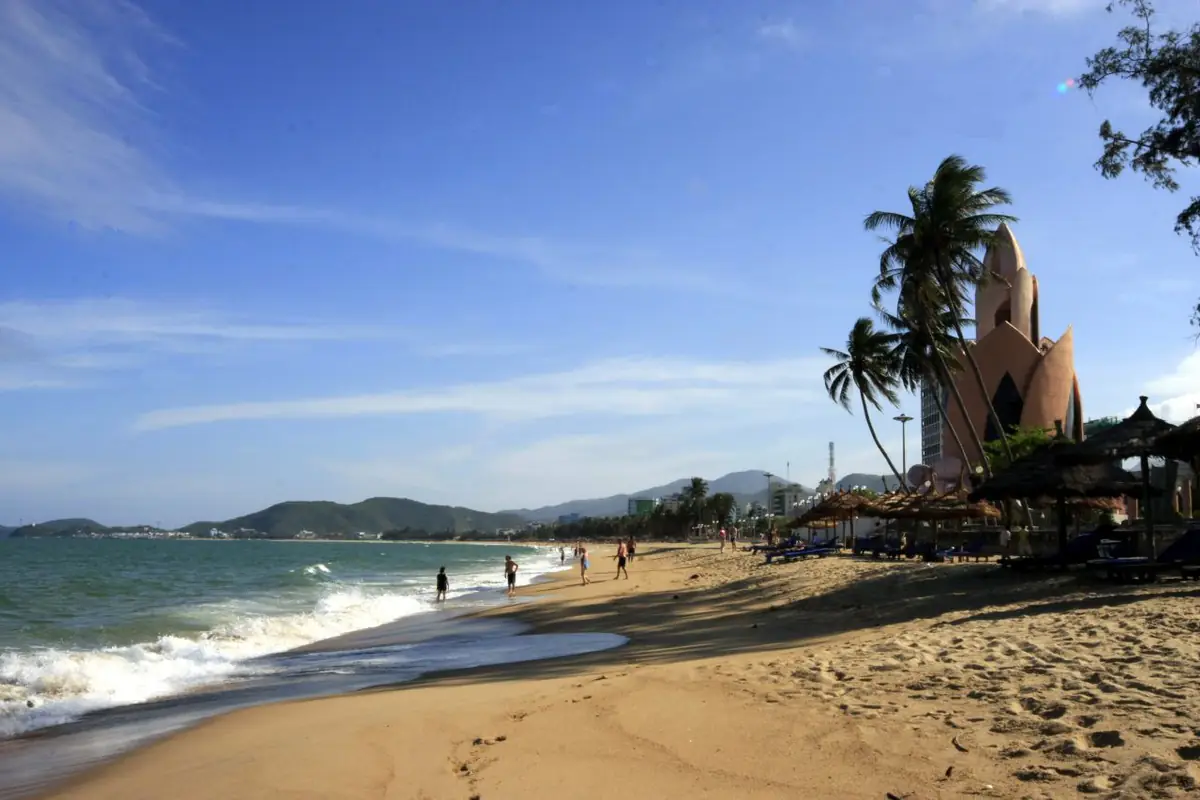
Tran Phu Beach runs alongside the city's main seafront road.
You can choose a stretch near 2/4 Square, Tram Huong Tower, or another open section close to your hotel.
Its biggest advantage is convenience.
Many hotels in central Nha Trang are only a few minutes' walk from the beach, so sunrise needs no separate excursion.

Photo: cloud.shepherd (Brian Miner)
A practical early-November schedule might look like this:
| Time | What to do |
|---|---|
| 5:10-5:15 AM | Arrive, find a dry area of sand, and check the view east |
| Around 5:20 AM | Watch the sky gradually brighten |
| Around 5:37 AM | Observe the calculated sunrise |
| After 6:00 AM | Walk along the beach or return to the hotel for breakfast |
These times are based on early November 2026. For other months, use the calculator and adjust your arrival time accordingly.
Tran Phu Beach is a sensible first choice if you want to see sunlight over the water.
However, the sunrise direction can line up with islands offshore, so you may not always see the sun rising from a completely unobstructed sea horizon.
Hon Chong: best for coastal rocks and sea views
Hon Chong lies north of central Nha Trang and is known for its large coastal rock formations.
Unlike the long sandy stretch of Tran Phu Beach, the area has rocky terrain and views across the bay from different angles.
Check the sunrise bearing on the calculator before choosing your viewpoint.

Photo: Vinhtantran
There is one important practical limitation: the Hon Chong attraction has its own access rules and opening hours.
Do not assume you can enter the designated rock sightseeing area before sunrise.
Check the attraction's access hours before planning a very early visit.
When early access is unavailable, choose a legally accessible public viewing area nearby or go to Tran Phu Beach instead.
Around the rocks, follow designated paths and avoid slippery edges or areas where waves reach the stones.
For a first visit with only one morning available, Tran Phu Beach is the easier option.
Hon Chong makes more sense if you have time to check access arrangements and specifically want a rocky coastal landscape.
Where to watch sunset in Nha Trang
Unlike west-facing beaches on some islands, central Nha Trang faces east.
The sun sets toward the inland mountains rather than over the open sea.
That makes elevated viewpoints and locations with western views more suitable for watching sunset.
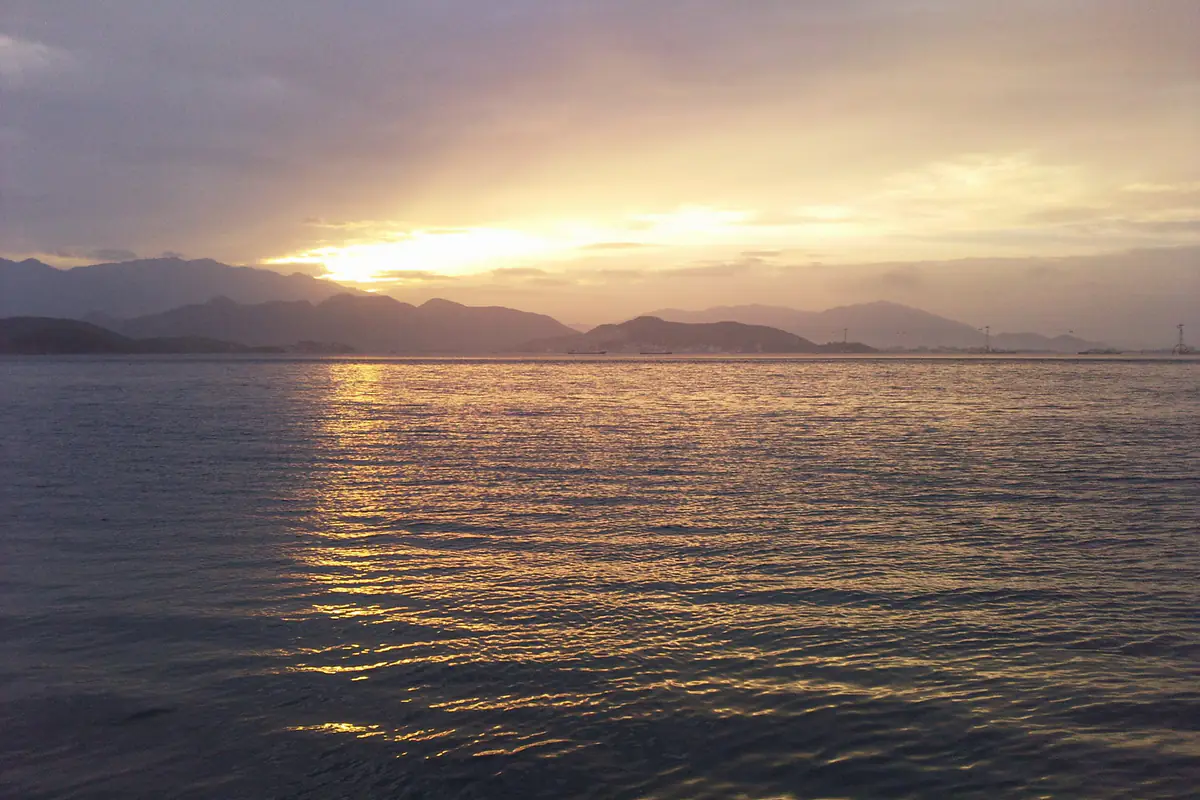
Photo: nguyenquoctuan
Loading map...
- Skylight Nha Trang: Rooftop on Tran Phu Street, no. 38
- Xom Bong Bridge: Crosses the Cai River near the Po Nagar Cham Towers
- Tran Phu Bridge: Crosses the Cai River, linking the center to the north
A Tran Phu rooftop: watching the city from above
One example is Skylight Nha Trang, located at the Premier Havana Hotel, 38 Tran Phu Street.
From its elevated viewing areas, you can enjoy views of the bay, the city, and the mountains to the west.
It is a suitable choice for travelers who want to combine evening scenery with a rooftop venue.
There is a timing issue worth checking: in 2026, the Rooftop Beach Club opens at 5:00 PM, while on November 6 the calculated sunset is around 5:16 PM.
For this reason, Skylight is not a reliable choice for seeing the entire sun descend below the horizon in early November.
It is better suited to watching the evening sky change color and seeing the city lights come on.
Before visiting, check the day's opening hours, access arrangements, and current admission or spending requirements.
The same principle applies to other rooftop venues.
An opening that late may be convenient at some times of year but too late for a full sunset experience when the sun sets early.
Xom Bong Bridge: river and mountain views
Xom Bong Bridge crosses the Cai River in northern Nha Trang, near the Po Nagar Cham Towers area.
It is an option to consider if you want to see the evening sky without visiting a rooftop.
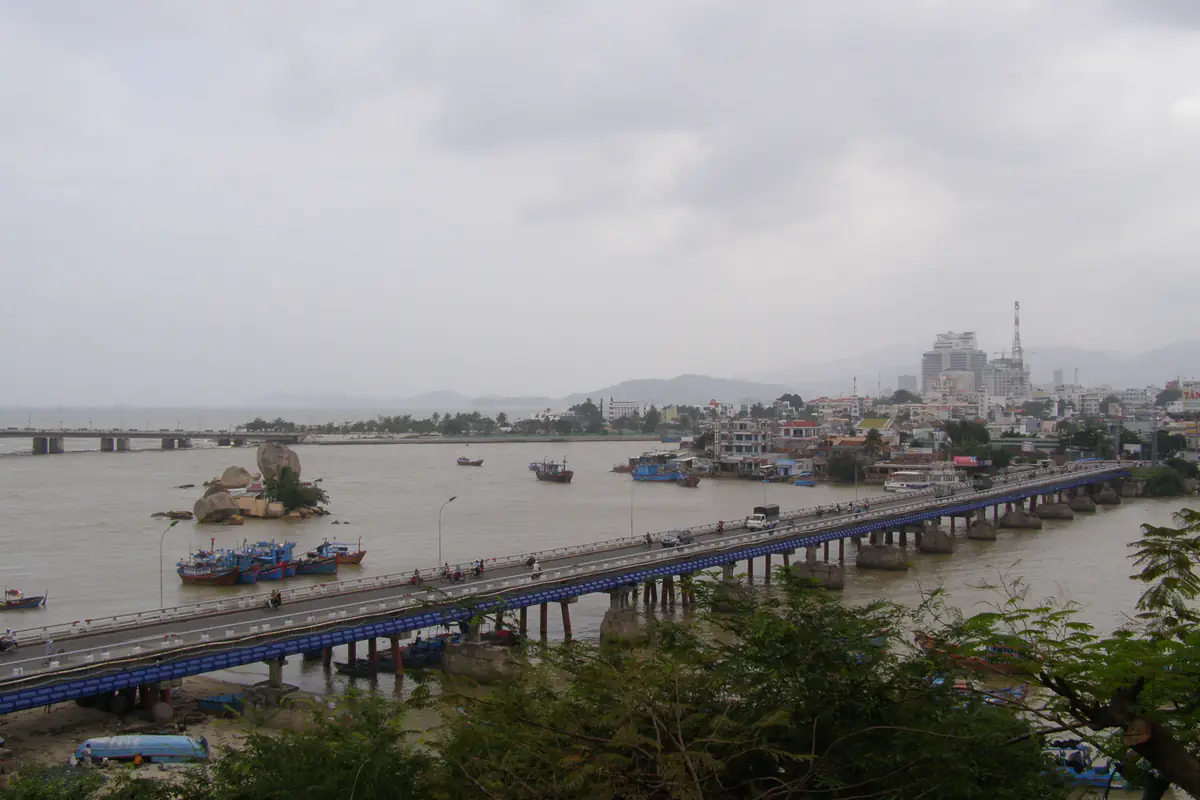
Photo: RG72
Before leaving, open the "Sunset" card and check the compass bearing.
At the location, look west toward the river corridor and mountains.
The water, boats, and riverside buildings create a different scene from the open beachfront.
However, the bridge is an active traffic route.
Stay within areas intended for pedestrians, do not stop in vehicle lanes, and never climb over the barriers.
A narrow or crowded pedestrian area is a cue to choose a legally accessible place near the bridge approach instead.
Tran Phu Bridge: convenient from the city center
Tran Phu Bridge also crosses the Cai River, connecting central Nha Trang with the northern side of the city.
For visitors staying near Tran Phu Street, it can be a convenient option for looking west without booking a rooftop venue.

Photo: Harri J
Aim to arrive around 4:35-4:45 PM, about half an hour before the calculator's sunset time.
That gives you time to check the direction and watch the changing light before the sun becomes hidden by the western landscape.
Do not wait until the exact sunset time to start looking, since some of the most noticeable changes in the sky happen earlier.
After the calculated sunset, you may be able to stay for the blue-hour period and see the city's lights gradually become more prominent.
Should you check sunset time or golden hour first?
With a location already chosen, such as Tran Phu Bridge, check the afternoon golden-hour period first to decide when to leave your hotel.
Without one, check the sunset direction first: a place can offer an excellent view of the sea while providing no direct view toward the setting sun.
For rooftop venues, there is another step: check the opening time.
The calculator does not verify the current operating hours of hotels, restaurants, rooftop bars, or sightseeing attractions.
For example, suppose sunset is at 5:15 PM and a rooftop opens at 5:00 PM.
You have only 15 minutes according to the astronomical clock. In practice, that may be even less because of the western mountains.
At a public viewpoint with legal pedestrian access, you may be able to arrive earlier and enjoy the full period leading up to sunset.
To enjoy the color of the sky after sunset even without seeing the solar disc, check the evening blue-hour period too.
What do "Next up" and "Share this day" mean?
The calculator has two additional features that can help you organize your visit.
"Next up"
The "Next up" line sits above the day buttons and shows the next solar event, its time, and the time remaining, such as "Next up: sunset at 17:16, in 11 min." It always counts from today, whichever day you are viewing; after sunset it switches to tomorrow's sunrise.
On an afternoon when sunset is the next event, you see the countdown without manually subtracting the current time from the sunset time.
The countdown runs to the astronomical event and ignores your travel time to a viewpoint. With sunset 20 minutes away and a 25-minute journey ahead, you no longer have enough time to arrive before the calculated sunset, so it may be more practical to choose a closer location and enjoy the remaining evening light.
"Share this day"
The "Share this day" button copies the selected day's solar information and its corresponding link, or opens the share sheet on devices that support it. If the browser blocks copying, the link appears in a box.
This is useful when traveling with friends or family.
Suppose your group plans to visit the beach on Sunday morning.
One person can select Sunday, press "Share this day," and send the result to the group chat.
Everyone can then see the relevant times without looking them up separately.
Check the selected date before sharing.
"Today" and "Tomorrow" follow the date in Vietnam, so for someone still abroad they can be a day off from the calendar on their phone.
Does the calculator work without internet access?
There are two separate parts to consider.
The solar calculations run in the browser using an astronomical algorithm.
Once the tool has loaded, it does not need a new network request to calculate sunrise, sunset, sun direction, golden hour, or blue hour.
Losing access to weather data does not remove the calculated solar times.
However, opening the page for the first time may still require internet access if the necessary files have not already loaded on your device.
The viewing-condition forecast is different.
Cloud cover, precipitation probability, and visibility come from Open-Meteo.
When the weather data cannot be loaded, the viewing outlook is hidden and a "Try again" button appears, while the astronomical information remains available.
The calculator cannot provide updated weather forecasts offline.
For a sunrise outing somewhere with unreliable mobile coverage, open the tool in advance to check the times, then check the weather again once you have a connection closer to departure.
Will the times change based on a foreign visitor's phone?
The calculator uses Vietnam Standard Time, UTC+7.
This matters if you are planning your trip from another country.
A sunrise time shown in the calculator is the time in Nha Trang, not in your home country.
Most phones update their time zone automatically after arriving in Vietnam when automatic time-zone settings are enabled.
Still, check your phone's clock before setting an early alarm.
The calculator uses fixed reference coordinates for Nha Trang and ignores your phone's current GPS location.
You can therefore plan your trip without enabling location access.
Three practical ways to choose your sunrise or sunset day
You have only one morning
Select "Tomorrow," open the sunrise card, and check the morning blue-hour time.
A "Favorable" label means planning to arrive at Tran Phu Beach before sunrise, ideally during the early part of the displayed light period. In early November, arriving around 5:10 AM is a reasonable starting point.
A "Mixed" label still supports a beach walk, with flexible expectations.
A "Poor" label is a reason to skip the early alarm when seeing the sun is your only reason for going out, and to use the morning for another activity instead.
You have one free evening
Open the sunset card, then check the compass direction and afternoon golden hour.
Choose Tran Phu Bridge or Xom Bong Bridge if you want a west-facing public viewpoint.
Choose a rooftop if you prefer to combine city views with an evening venue, but check its opening hours.
In early November, arriving at a suitable outdoor viewpoint around 4:30-4:45 PM gives you more time before sunset.
When sunset is around 5:15 PM, leaving your hotel at 5:00 PM may be too late to see much of the period before the sun disappears.
You are staying in Nha Trang for three days or more
There is no need to schedule sunrise and sunset on the same day.
Open each date in the row of day buttons and compare the viewing outlook labels for both events.
Suppose Saturday morning has heavy low cloud cover while Sunday morning is marked "Favorable."
You can spend Saturday exploring the city and save your sunrise outing for Sunday.
Similarly, an evening with likely rain gives little reason to book a rooftop venue just because it is your first day in Nha Trang.
Whatever you choose, check the forecast again closer to the time you plan to leave.
The viewing outlook may change when newer forecast information becomes available.
Important limits of sunrise and sunset calculations
The displayed times are astronomical calculations for a reference location in Nha Trang, based on a flat-horizon assumption.
They are not measurements of the exact moment the sun becomes visible from every beach, hotel, bridge, or rooftop.
Three practical limits are worth remembering.
The first is terrain. Mountains west of the city can block the sun before its calculated setting time. Offshore islands and low clouds can also delay the moment you first see the sun in the morning.
The second is weather. The astronomical algorithm calculates where the sun should be. Open-Meteo helps estimate visibility conditions, but neither guarantees clear skies.
The third is access and safety. The calculator cannot replace information about attraction opening hours, permission to enter a location, sea conditions, or severe-weather warnings.
For anyone visiting Tran Phu Beach at sunrise, walking along the shore is different from going into the sea.
At Hon Chong, keep away from rocks exposed to breaking waves and do not enter restricted areas.
When it is still dark, use clearly marked routes and stable walking surfaces.
If thunderstorms, strong winds, or hazardous-weather warnings are in effect, skip plans involving exposed rocks, the water's edge, or elevated outdoor viewpoints.
A "Favorable" viewing outlook measures only certain conditions relevant to seeing the sun. It is not a substitute for safety information.
If you are choosing between an early beach visit and an evening rooftop, start with sunrise at Tran Phu Beach on your first trip to Nha Trang. It is easy to reach from the city center, does not depend on rooftop opening hours, and faces the morning sun. Check tomorrow's sunrise time and viewing conditions, then plan to arrive about 20-30 minutes early.
FAQ
What time is sunrise in Nha Trang today?
On November 6, 2026, sunrise in Nha Trang is approximately 5:37 AM, Vietnam time (UTC+7). The exact time changes daily, so check the "Today" option on the calculator for your travel date. If you want to see the sky before sunrise, arrive at the beach about 20-30 minutes early and check the blue-hour time as well.
What time is sunrise in Nha Trang tomorrow?
On Saturday, November 7, 2026, sunrise is approximately 5:38 AM. Select "Tomorrow" to see the tool's time, sunrise direction, golden hour, blue hour, and viewing outlook. For visits on later dates, use the currently displayed date instead of relying on these November reference times.
What time is sunset in Nha Trang?
On November 6, 2026, sunset in Nha Trang is approximately 5:16 PM. Sunset times change throughout the year and are generally earlier in November than in the summer months. Because mountains lie west of Nha Trang, the sun may disappear from view before the calculated astronomical sunset.
Where is the best place to watch sunset in Nha Trang?
Tran Phu Bridge and Xom Bong Bridge are options for looking west toward the Cai River and surrounding mountains. Rooftop venues such as Skylight on Tran Phu Street offer elevated city views, although opening hours may limit the opportunity to watch the sun itself set. Tran Phu Beach is generally a better choice for sunrise because the central coastline faces east.
Can I use the Nha Trang sunrise calculator offline?
The sunrise, sunset, direction, golden-hour, and blue-hour calculations run in your browser after the necessary page files have loaded. These calculations do not require a live weather-data connection. However, the viewing outlook depends on forecast information from Open-Meteo and may be unavailable without internet access.
Related posts
Tools
Can you swim in Nha Trang today? Check the sea conditions
Learn how to check today's Nha Trang sea conditions and decide whether swimming or an island trip is a good idea.
Weather
Is Nha Trang Weather in February Good for a Beach Trip?
We suggest a February plan that leaves space for the beach without making every day depend on a boat.
Places
Go to Nha Trang for a Beach Beside the City
Choose Nha Trang when you want beach time with city life close at hand.