Visit Long Son Pagoda in Nha Trang without missing the white Buddha
If you want the hilltop white Buddha and city views, arrive in the morning and allow about 90 minutes for the climb and temple grounds. If you are visiting with older relatives, the main pagoda is worth seeing even without taking the stairs to the summit.
Written by Tụi mình mê biểnUpdated
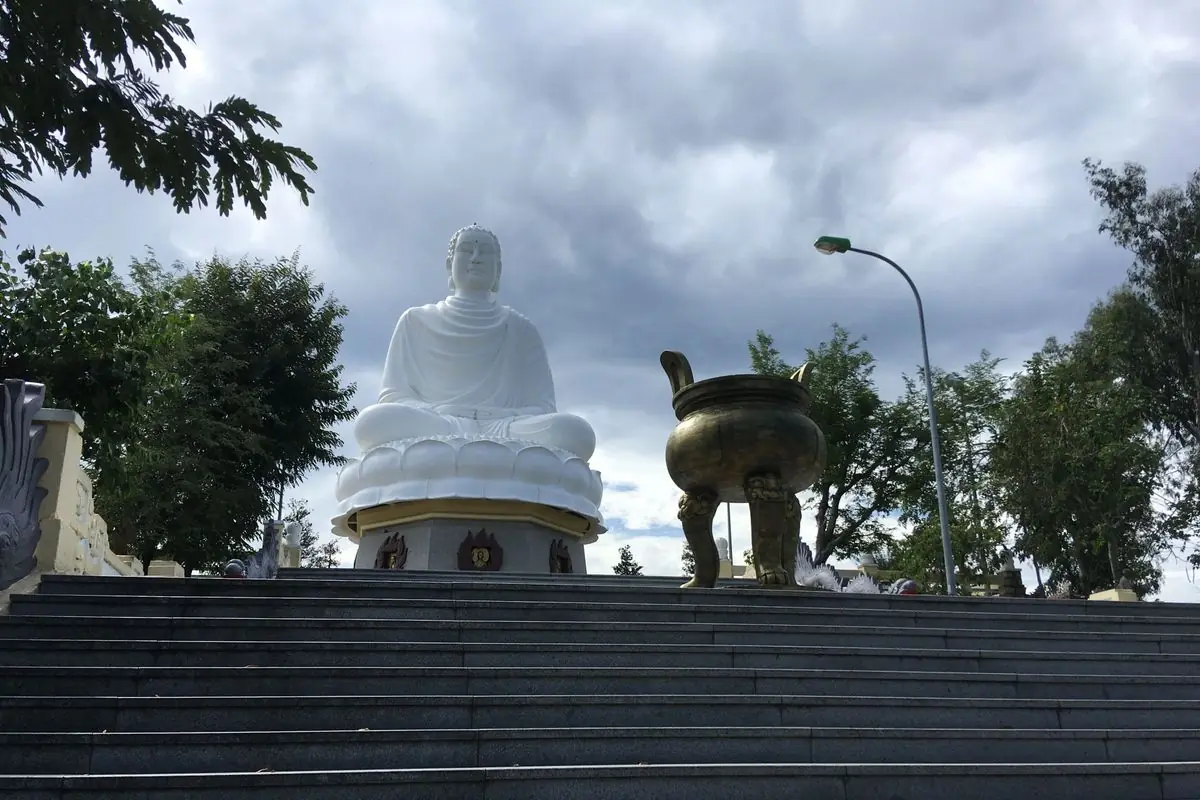
Photo: Christophe95
The large seated white Buddha above Nha Trang is reached by a staircase rising behind Long Son Pagoda on Trai Thuy hill. The pagoda is at 22 23 Thang 10 Street, admission is free, and visiting hours are 07:00-17:30. Allow 60-90 minutes if you intend to see the main temple, walk up the hill and spend time looking across the city.
Where is Long Son Pagoda in Nha Trang?
Long Son Pagoda sits just west of central Nha Trang, at the base of Trai Thuy hill. It is a city sight you can reach on your own. Enter Long Son Pagoda, 22 23 Thang 10 Street, Khanh Hoa into your map app. You may see the older ward name, Phuong Son, or the newer administrative name, Tay Nha Trang. Both descriptions refer to the same pagoda complex.
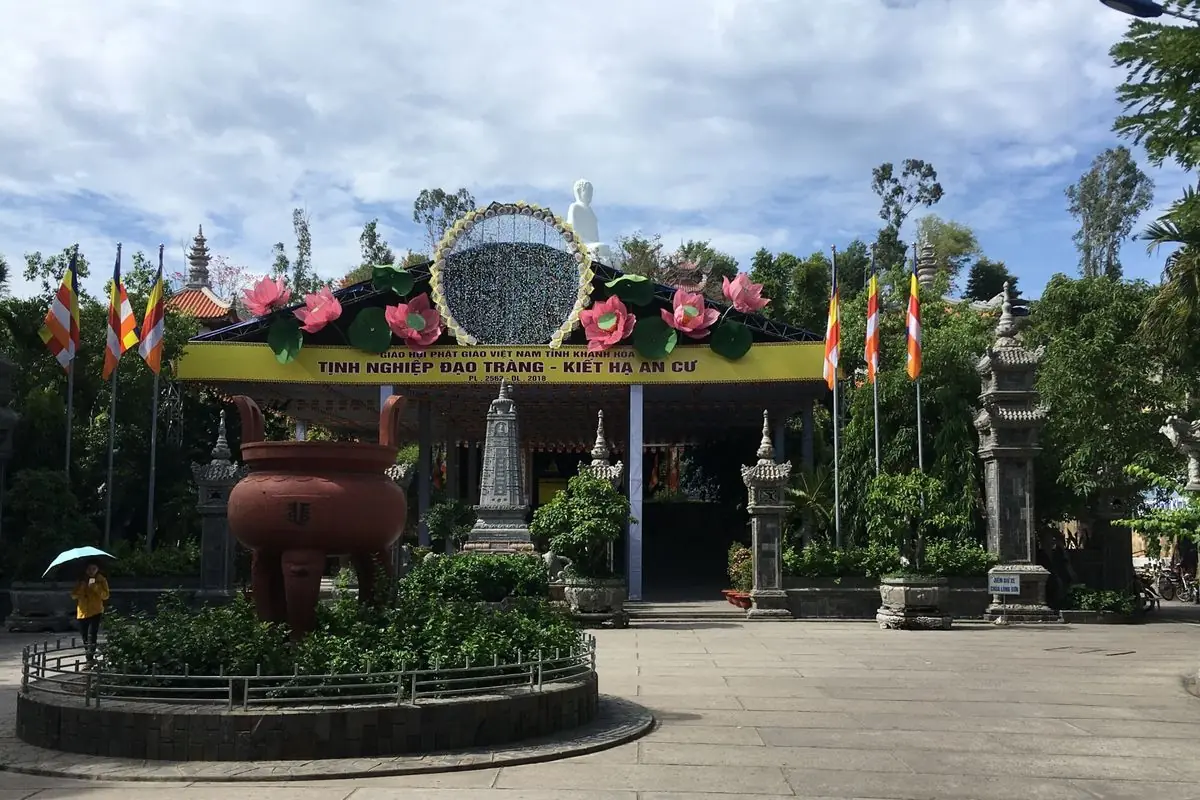
Photo: Christophe95
The temple is not on the beachfront. From hotels near Tran Phu Street, the beach promenade or 2 April Square, a taxi or app-booked car is the most straightforward option. The journey is only a few kilometers from much of the central hotel area and usually takes around 10-15 minutes in light traffic. Allow longer at busy junctions. Reaching the entrance takes no guide or city tour.
Walking is reasonable from accommodation near Nha Trang railway station or Thai Nguyen Street. From the southern or central beachfront, walking in the midday sun may make little sense when you still have a staircase ahead. On a motorbike, follow the main roads toward 23 Thang 10 Street and park at an appropriate area near the entrance. Ask the parking attendant about any charge before leaving the vehicle, and retain the parking ticket when one is issued.
Long Son is close enough to Nha Trang Cathedral, also known as the Stone Church or Mountain Church, to combine the two without wasting much travel time. It also fits into the same morning as Po Nagar Cham Towers. You will get more out of the visit if you understand that these are three different active religious sites, not just three photo stops.
Long Son Pagoda opening hours: what should you plan around?
Long Son Pagoda opening hours for sightseeing are 07:00-17:30. You may hear that the temple is open throughout the day or even accessible around the clock, but that is not the same as every hall, walkway and hilltop section being open to sightseeing visitors at night.
For a predictable visit, plan to arrive between 07:00 and 17:30, preferably at 07:00-08:30 if you intend to climb. Morning is better for temperature and gives you enough time to explore without rushing. An afternoon visit can work with an arrival around 15:00-16:00, well before the 17:30 close.
The main hall serves worshippers, and access can be affected by ceremonies, cleaning or local arrangements. On the first and fifteenth days of the lunar month, Buddhist holidays and other important occasions, more people may be coming to pray. That is not a problem if your purpose is worship. It can be inconvenient if your priority is a quiet photograph or a quick climb before another booking.
Is Long Son Pagoda free to enter?
Yes. Long Son Pagoda admission is free (VND 0). You can visit the main grounds and take the standard walking route toward the white Buddha without paying a temple entrance fee. You are not required to purchase incense, postcards or blessings. There is also no compulsory donation for taking the steps or entering the main worship area.
You may choose to make a donation as a personal religious or charitable act. Any donation goes into a clearly designated donation box within the temple. Do not give cash to a person who approaches you on the steps and claims to be collecting it for the monks. The fact that someone wears a badge, carries a booklet or offers to show you a shrine does not make their request an official entrance charge.
Transport, parking and purchases from shops are separate expenses. Ride-hailing apps give the fare before you confirm; for motorbike parking or refreshments, check the price before using the service. A tour company might charge for a guide, a vehicle and other inclusions, but that is the tour operator's package price; the pagoda itself stays free.
On a tight budget, this is one of the easier cultural stops to arrange independently. The most useful thing to bring is not a large amount of cash but water, suitable clothing, comfortable footwear and enough time to go at your own pace.
How many steps are there to the white Buddha?
152
steps, the usual count
150-200
stone steps to prepare for
14 m
the statue itself
60-90 min
for the full visit
The commonly quoted figure is 152 steps to the white Buddha at Long Son Pagoda, though another count gives 193 steps. Neither figure is beyond dispute, so the practical answer is to prepare for roughly 150-200 stone steps, with places to stop on the way up.
This is not a continuous indoor flight of stairs. The ascent passes several temple features and outdoor landings. Break it into sections, pause to see the reclining Buddha and continue when ready. The exposed stretches feel more demanding in strong sunlight, particularly after you have already walked around the city or spent the morning on the beach.
The staircase is manageable for many adults with ordinary mobility, but “manageable” does not mean effortless for everyone. Nobody is obliged to complete it, least of all visitors with knee pain, limited balance or a medical reason to avoid a climb. The lower pagoda is a visit in its own right. The stairs also make the hilltop unsuitable for visitors who need step-free wheelchair access or who would otherwise rely on a stroller.
Wear shoes with good grip, carry a small bottle of water and keep at least one hand free. Stop on a landing when you want to take photographs. Looking through a phone screen while walking backward on the steps is an unnecessary risk, especially with people passing in both directions.
Start with the main hall, not the photo at the summit
Many visitors rush through the lower compound because the white Buddha is visible in almost every photograph of the place. The main pagoda is not simply an entrance building. Its tiled roofs, decorative dragons, altars and open courtyards belong to an operating Buddhist temple with a long place in the religious life of Khanh Hoa.
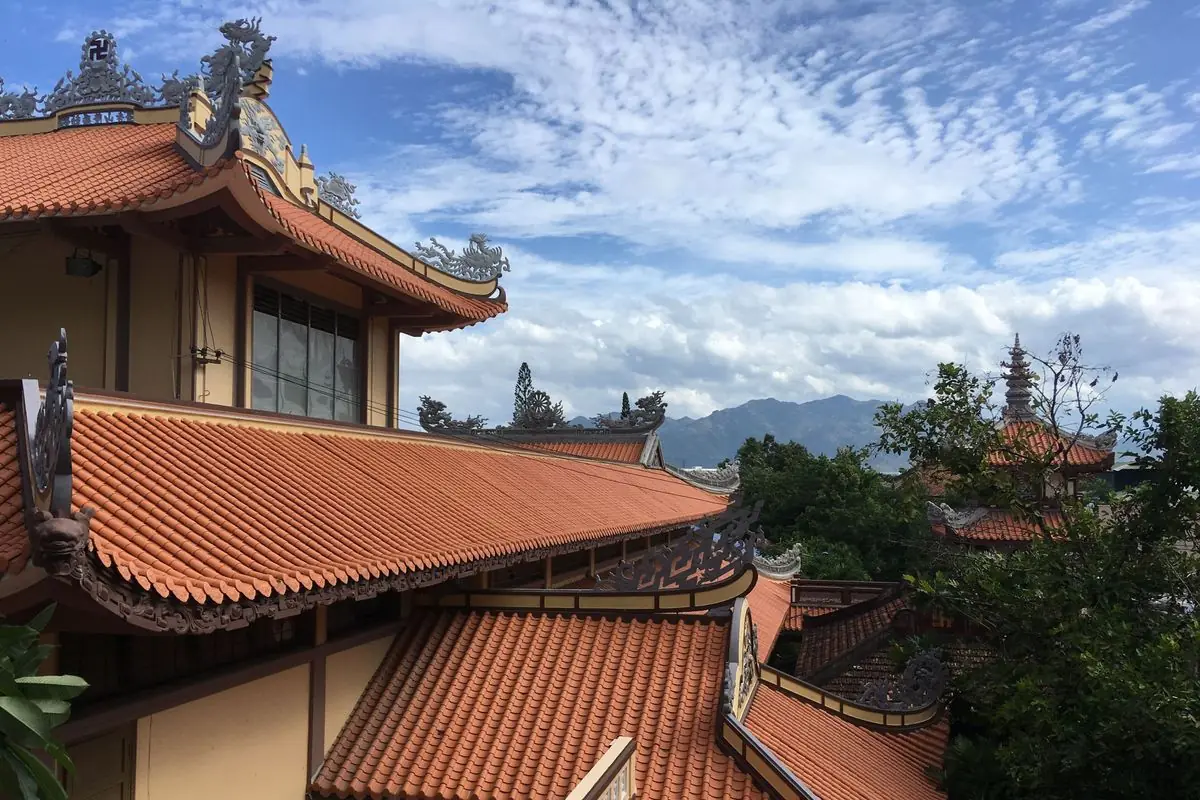
Photo: Christophe95
Spend 15-20 minutes at ground level before starting uphill. Look at the rooflines and decorative details from the courtyard. If the main hall is open to visitors, follow posted signs about shoes, hats and photography before entering. Worshippers may be praying, placing offerings or joining chanting; leave enough space for them to move comfortably.
You do not have to be Buddhist to visit. Equally, respect does not require imitating a ritual you do not understand. Stand quietly, keep conversation low and avoid walking directly in front of someone praying. A roped-off, reserved or temporarily closed area matters more than a photograph you saw online.
Architecture fans will find this lower section worth the time. The curve of the roofs and details on the columns are easier to appreciate from nearby than from the hilltop. It also provides context: the large Buddha belongs to a working religious complex.
Follow the uphill route past the reclining Buddha
From the lower grounds, take the marked staircase toward Trai Thuy hill. The path leads past a reclining Buddha, an image associated with the Buddha's passing into nirvana. It is an easy place to pause and often the first point where visitors slow down after the initial run of steps. The decorative figures behind the reclining statue are worth a proper look.
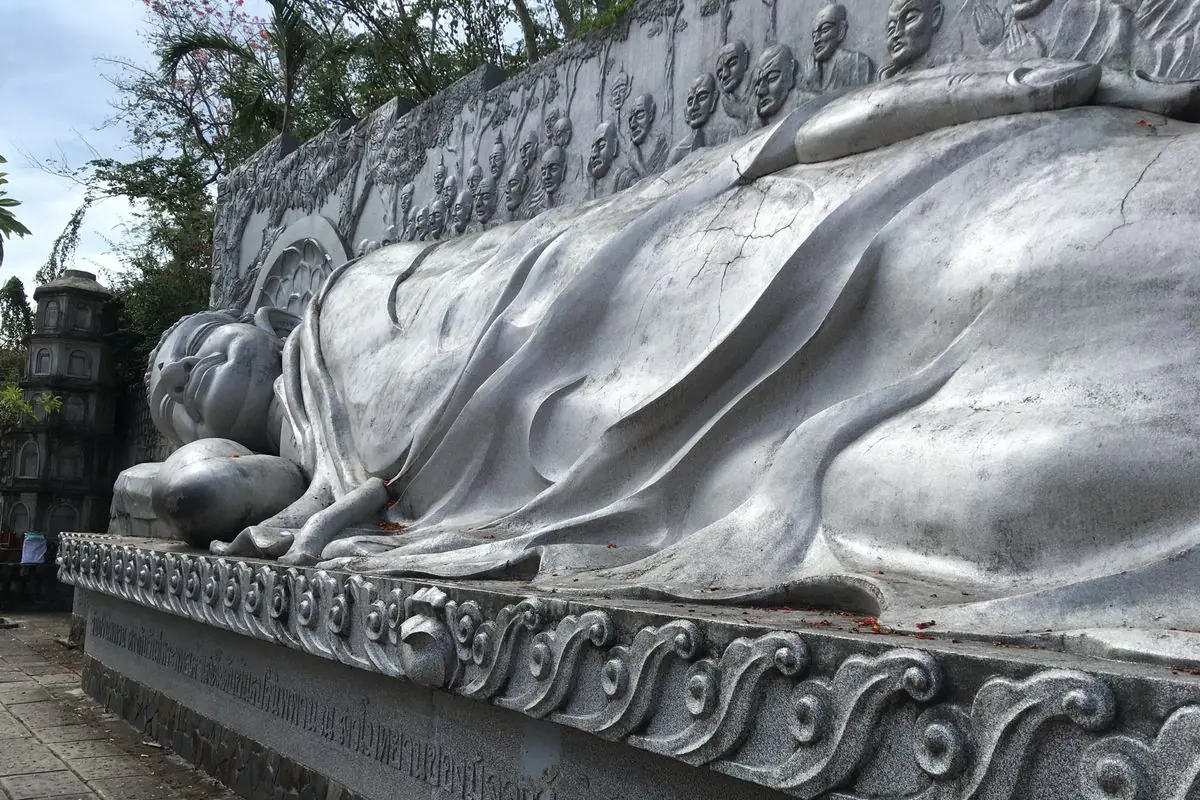
Photo: Christophe95
There is also a bell area along the uphill route. You may hear bells at certain times, but do not ring one yourself unless explicitly invited or permitted by temple staff. Sacred objects are part of the temple's religious use. The same applies to statues, offerings and areas where people are praying.
Take the ascent at a steady pace. Anyone who appears beside you offering “help” or “the correct route” can be politely turned down. The regular walking path and temple signs are enough for an independent visit. If you are genuinely unsure which way to go, ask at the main hall or in a clearly managed temple area instead of agreeing to an unsolicited private tour.
At the final section, the great seated white Buddha becomes the dominant feature above the steps. It sits on a lotus pedestal and is commonly called Kim Than Phat To in Vietnamese. The statue itself is about 14 meters high. The figure of approximately 24 meters refers to the larger statue-and-base structure. The difference comes down to what is included in the measurement.
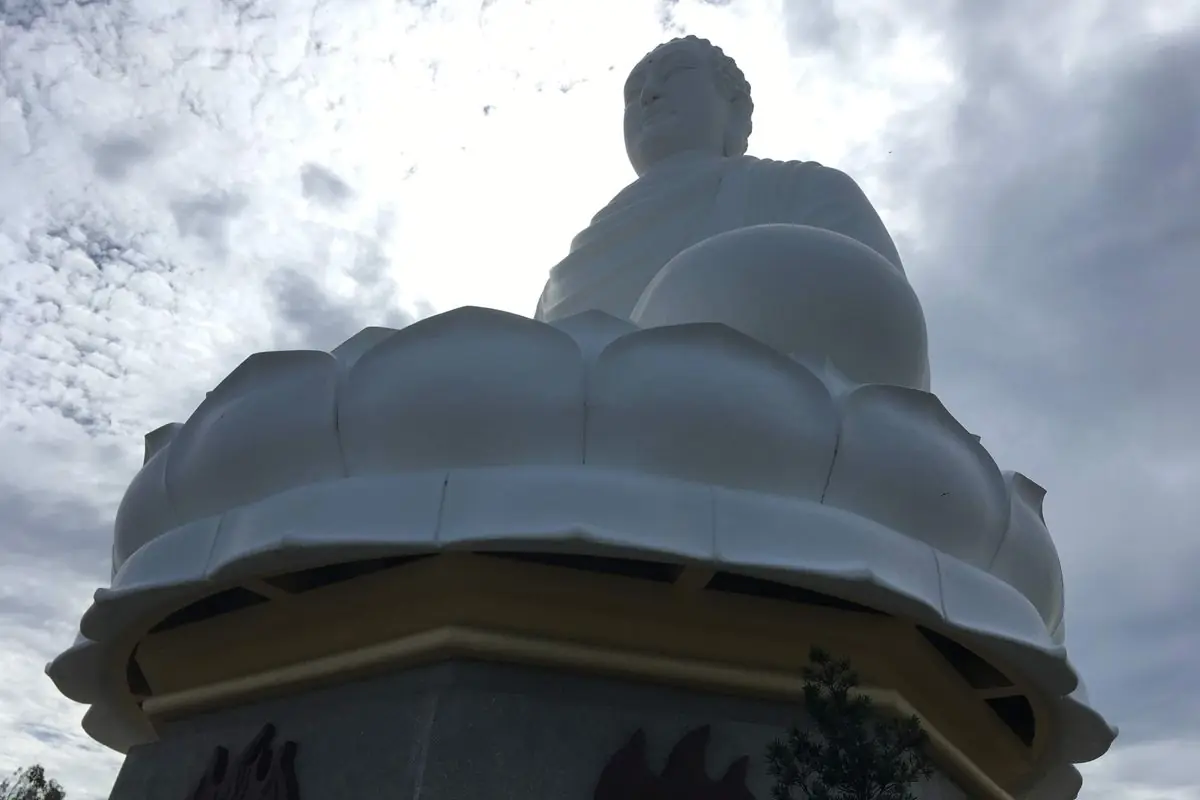
Photo: Christophe95
Where are the best views from the white Buddha?
The most straightforward viewing spot is the open area around the base of the seated white Buddha at the top. From the hill you can see sections of Nha Trang's streets and buildings, surrounding slopes and, in clear conditions, views toward the coastline. The scene is more of an elevated look across the city than an unobstructed 360-degree viewing platform. Trees and buildings cover some directions.
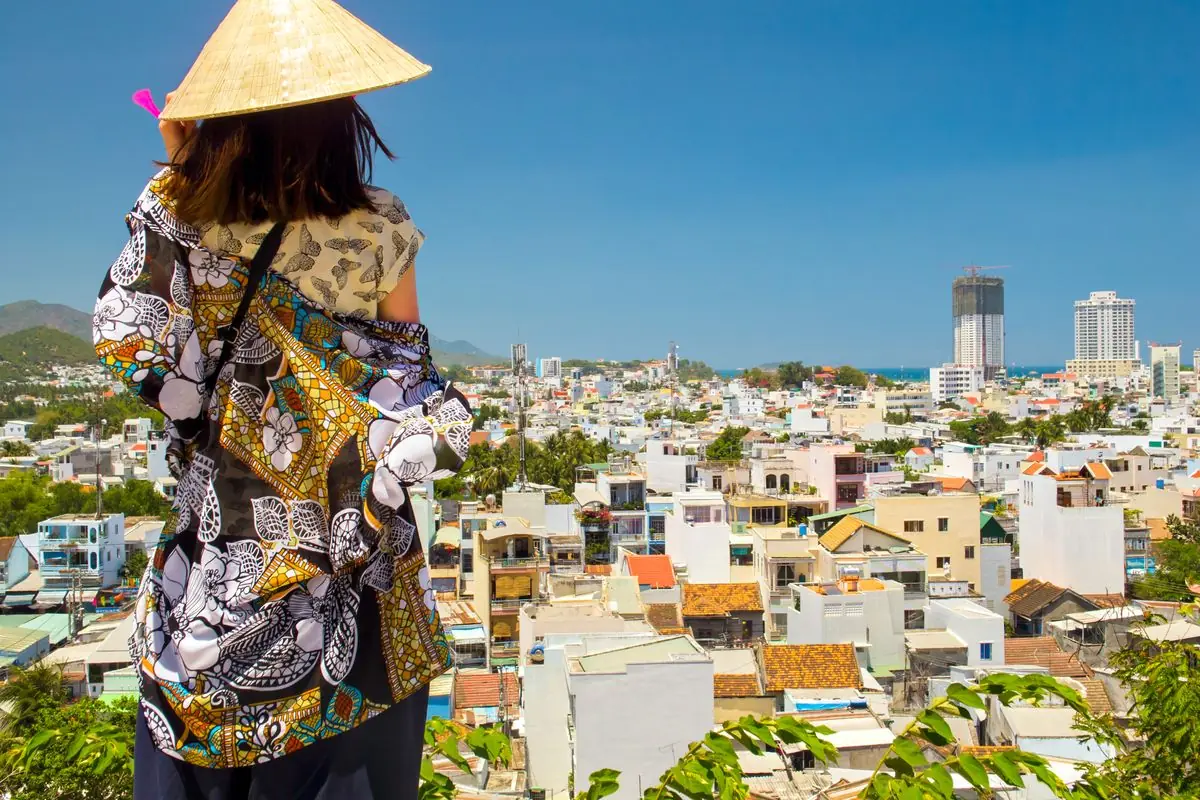
Photo: Михаил Лазарев
Stand back far enough to include the lotus pedestal when you photograph the statue. A wider view also helps show the scale of the Buddha against the hill. City shots work best from an opening between trees within the public parts of the terrace; climbing onto walls or edging around a barrier is off-limits.
The morning visit is the most dependable choice even for people who care about pictures. Strong midday light can produce hard shadows and make the staircase uncomfortable. Late afternoon can offer interesting side light, but you have less freedom to stay once the recommended visiting window is nearing its end.
Expect company at the best viewpoint. Someone may be kneeling, praying or walking around the statue. Give them room, wait a moment and take your photograph without turning a place of worship into a staged photo session. Drones, tripods and professional shoots should not be assumed to be allowed; ask permission if you plan equipment beyond ordinary handheld photography.
What should you wear at Long Son Pagoda?
Choose clothing that covers your shoulders and knees. A T-shirt with loose trousers, a long skirt or similarly modest outfit is suitable for most visitors. Shoes should have enough grip for the stone steps and be easy to remove if you enter an area where footwear is not permitted. Formal clothing is unnecessary, but beachwear, very short shorts and sleeveless tops are poor choices for the worship spaces.
This matters if you are fitting the pagoda into a beach holiday. Packing a lightweight shirt and a pair of longer trousers makes the change simple. Borrowing a wrap or scarf at the gate is not a safe bet; there may not be any available when you arrive.
Inside the temple, check local signs before using your phone or camera. Remove hats where requested, silence notifications and avoid flash photography around people praying. Do not stand in front of an altar to take a portrait or interrupt a ceremony because the lighting is attractive. A temple worker may ask visitors to move aside; follow the instruction without making an issue of it.
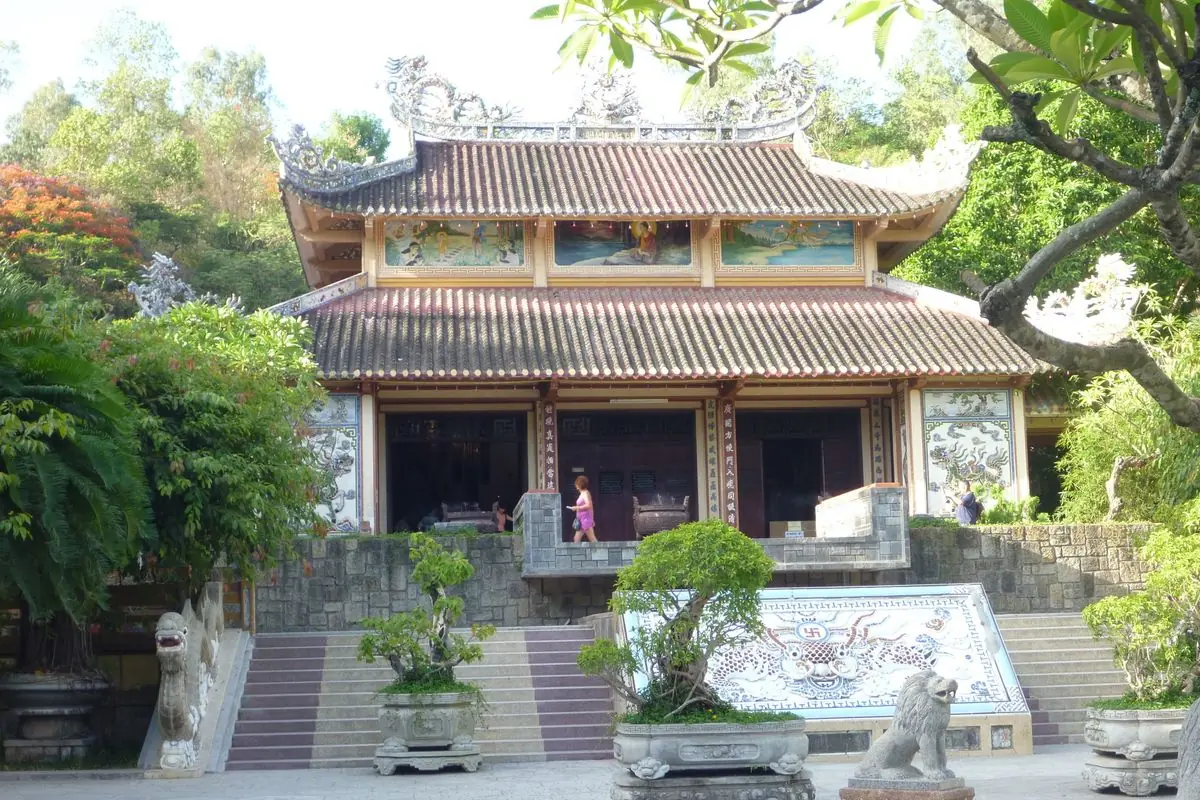
Photo: Nonvolatil
Families should explain to children that the main hall is not a play space. Groups should keep conversations at a normal quiet level and wait outside for late-arriving friends. These customs are useful at nearly every active temple, cathedral and shrine in Vietnam.
Long Son Pagoda scams: how to handle unwanted guides and donations
Searches for “Long Son Pagoda scam” point to a real concern. People approach visitors with offers to show them around, sell incense or postcards, or collect money supposedly for the temple. Some offers begin as friendly conversation and end with pressure to pay. Near the entrance, there are also sellers and people offering motorbike rides toward the hilltop.
There is no reason to assume that everyone selling something outside the pagoda is dishonest. The issue is pressure, unclear terms and claims of authority that you did not agree to. Agree on what an item or paid service is and what it costs before accepting it. Otherwise, declining immediately is easier than trying to end an unwanted guided visit halfway up the hill.
Someone may wear a printed name badge and say a payment is compulsory; there is no point debating whether the badge is genuine. There is no standard admission ticket to Long Son Pagoda. Ask at the temple's managed area if you want to verify a claim. Donations go directly into an identifiable donation box, never to a person following visitors around.
Be cautious about offers to take you to the white Buddha by motorbike. The normal visitor route is the staircase through the temple complex. An unsolicited ride is not a required part of the visit, and a shortcut should not be accepted just because somebody claims the walking path is closed. Visitors who cannot take the stairs can enjoy the lower pagoda instead, a perfectly reasonable choice.
If someone continues following you, move toward other visitors or an area supervised by temple personnel. Keep your wallet and phone secure, particularly when you are taking photos or putting shoes back on. There is no need to escalate a disagreement over a small request for money. A clear refusal and a move to a busier area are usually more useful than an argument.
Travelers who prefer a guided explanation can book a clearly priced tour from an identifiable operator before arriving. Ask whether transport, guide time and any other admission tickets are included. Paying for a genuine optional service is different from being pressured into an undefined donation after an unsolicited conversation.
When is the best time of year to visit?
The white Buddha is outdoors, so the weather matters more than it does for a quick visit to an indoor gallery. On sunny days, the stone staircase can become uncomfortable around 11:00-14:00. Start early. Spend the hotter part of the day at lunch, resting at your hotel or visiting a less exposed attraction.
Lunar New Year, the first and fifteenth lunar days, Vesak and other Buddhist occasions may bring many local worshippers. Those dates can be meaningful if your reason for visiting is to observe religious life respectfully or join an appropriate ceremony. A quiet architectural visit with fewer people in your frame works better on an ordinary weekday.
The practical distinction is between a worship visit and a sightseeing visit. A worshipper may be happy to come when the grounds are busy. Someone traveling with a toddler, an older parent or limited time will often appreciate a calmer morning with an easier staircase.
Is Long Son Pagoda suitable for older visitors and children?
The first question for older visitors is whether reaching the statue matters to them. Let them decide whether the summit is worth it. A comfortable visit around the main hall and courtyard can take 30-45 minutes without the full climb. Leave time for them to try some steps and turn around without delaying an onward booking.
Children need water and footwear that stays secure on the feet. An early visit is generally easier than arriving after a long beach morning when everyone is tired. Hold a young child's hand where the staircase is busy, and stop to look at a view instead of allowing children to move toward an edge while adults take pictures.
A stroller or wheelchair will not take you up the ordinary stair route to the white Buddha. This is an important limitation to plan around. If someone in your group needs step-free access, do not rely on a stranger's offer of a motorbike shortcut as an accessibility solution. Concentrate on the areas that are comfortably accessible to your group and adjust the rest of the itinerary.
The naming can confuse international visitors. Long Son Pagoda refers to the temple complex; white Buddha Nha Trang usually refers to its most famous statue higher on Trai Thuy hill. Begin at the pagoda gate, carry a modest outfit and remember that entrance is free. Even without Vietnamese, navigating independently is easy.
People coming specifically to pray may want to spend more time at ground level and follow the temple's own schedule. Those who are visiting mainly for architecture do not have to interrupt ceremonies or perform unfamiliar gestures. Both visits can be respectful, as long as the place is treated as a living Buddhist temple rather than just an Instagram backdrop.
Combine Long Son, Nha Trang Cathedral and Po Nagar in half a day
One morning of cultural sightseeing can combine three different sites: Long Son Pagoda, Nha Trang Cathedral and Po Nagar Cham Towers. Each represents a different religious and architectural tradition. The route works well by taxi or ride-hailing car, but do not expect to cover them properly in an hour. Set aside roughly 3.5-4.5 hours, including short transfers and a water break.
Loading map...
- Long Son Pagoda: 22 23 Thang 10 Street, first stop, free entry
- Nha Trang Cathedral: Second stop, avoid Mass times
- Po Nagar Cham Towers: Last stop, separate entrance charge
| Suggested time | Stop | What to do |
|---|---|---|
| 07:15-08:30 | Long Son Pagoda | Visit the main hall first, then climb toward the white Buddha if your group is comfortable. |
| 08:45-09:20 | Nha Trang Cathedral | See the stone architecture; enter only when visitor access is permitted and avoid disturbing Mass. |
| 09:40-10:40 | Po Nagar Cham Towers | Walk around the Cham towers, keeping clear of active worship areas. |
| After 10:40 | Return to the center | Have an early lunch or rest before your afternoon plans. |
The times are a workable sample itinerary, not confirmed appointment slots. The cathedral is an active Catholic church. Its interior may not be available for sightseeing during Mass or other services, particularly on Sundays. If a ceremony is underway and you are not attending it, see the exterior and move on.
Po Nagar is also an active place of worship and has a separate entrance charge. Check the posted notice at the ticket counter on the day for its current ticket amount and hours rather than relying on an older rate. The same modest dress you wore at Long Son is a good starting point for both other sites.
Two hours is enough for either a full Long Son visit or a shorter look at the lower pagoda plus the cathedral. Trying to squeeze the white Buddha climb and all three attractions into a tight transfer window will leave no room for crowds or changing access rules. With a mobility-limited companion, it is better to visit fewer sites comfortably.
You can reverse the route if your accommodation or another appointment makes that convenient, but keep the Long Son climb within the reliable daytime window. On a rainy day, consider visiting the lower temple only and leaving the exposed hilltop steps for clearer weather. Let the timetable bend to your group when conditions change.
What to check before leaving your hotel
Bring a shoulder-covering top, trousers or a below-knee skirt, secure shoes, water and a phone with enough battery for maps and transport. Save Long Son Pagoda, 22 23 Thang 10 Street as your destination rather than relying on a generic photo location for the white Buddha. Anyone continuing to the cathedral and Po Nagar should check their visitor notices for that day, especially on Sundays and religious holidays.
Keep cash only for expenses you choose to incur, such as a parking space, food or a donation. Check each price with the provider instead of accepting claims about a compulsory temple fee. Give yourself permission to stop at the main hall if the sun is too strong, the staircase is wet or somebody in the group is tired.
The simplest way to enjoy Long Son Pagoda is to arrive early, see the working temple at ground level and decide on the white Buddha climb after checking the weather and your group's energy. The same habits (modest dress, clear agreement on paid services and consideration for worshippers) will help at Po Nagar and other religious sites around Vietnam.
FAQ
Where is Long Son Pagoda in Nha Trang?
It is at 22 23 Thang 10 Street, beneath Trai Thuy hill. The older ward name is Phuong Son; the newer one is Tay Nha Trang Ward. Search for Long Son Pagoda itself rather than a separate white Buddha vehicle route.
How many steps are there to the white Buddha at Long Son Pagoda?
152 steps is the figure most often quoted, though another count gives 193. Prepare for roughly 150-200 steps and take breaks as needed.
What are Long Son Pagoda's opening hours?
Visiting hours are 07:00-17:30. You may hear that the grounds are open more widely, but that does not guarantee full sightseeing access at night. A daytime visit, ideally early morning, is the safest plan.
Do I need a ticket or a mandatory donation?
No. Admission is free, including the normal walking route toward the white Buddha. Donations are optional. Transport, parking, purchased items and pre-booked guided services are separate costs.
Is there a Long Son Pagoda scam I should watch for?
Watch for unsolicited guides, pressure to buy incense or postcards, and requests for money supposedly on behalf of the temple. Decline services you did not request, do not treat an unofficial demand as an entrance fee, and use the temple's clearly marked donation box if you choose to give.
Related posts
Places
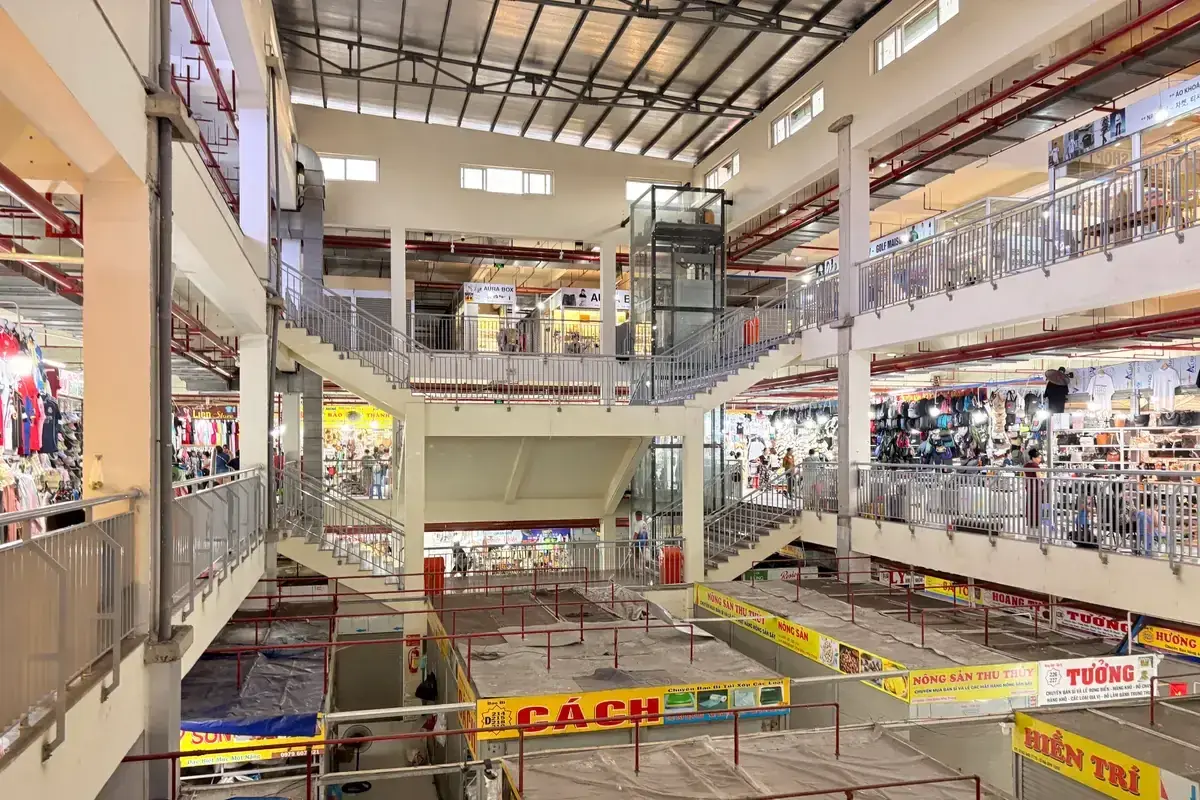
Dam Market Nha Trang: 3 floors, opening hours and shopping guide
A practical morning plan for food, souvenirs and shopping at Dam Market.
Places
Nha Trang Cathedral is worth visiting, but not during Mass
Visit Nha Trang's famous Stone Church at the right time and without interrupting Mass.
Places
VinWonders Nha Trang for families: is a full day worth it?
A practical guide to tickets, family attractions, and spending a full day at VinWonders Nha Trang.