Nha Trang Cathedral is worth visiting, but not during Mass
Nha Trang Cathedral has no admission fee, and 30-45 minutes is enough for most visitors. Come in the morning or early afternoon, outside Mass times, to explore its architecture without disturbing worshippers.
Written by Tụi mình mê biểnUpdated
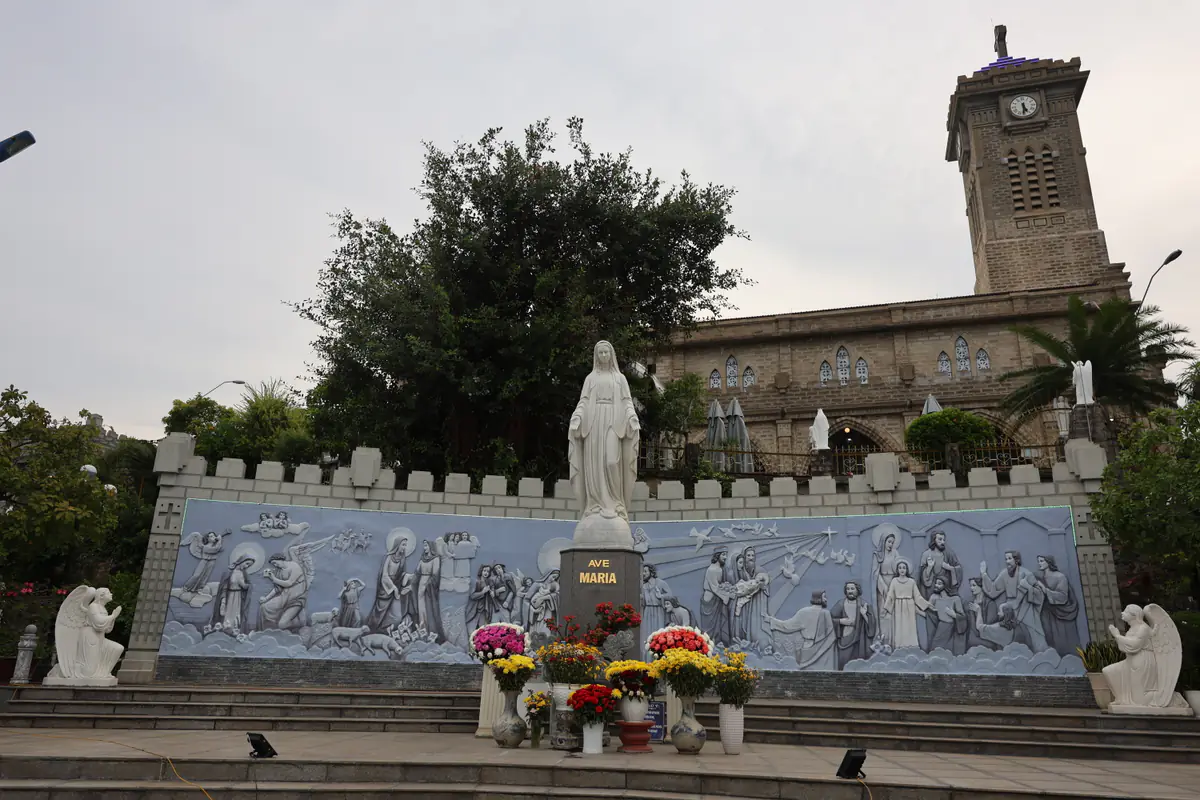
Photo: Vinhtantran
A short walk from Nha Trang Railway Station along Thai Nguyen Street brings you to the Nga Sau intersection, where the cathedral's clock tower rises above the surrounding buildings. Officially known as Christ the King Cathedral, this stone church was started in 1928 and completed in 1933. You don't need to be Catholic to visit, and general admission is free, but opening hours, access to the interior, and Mass times are not the same thing.
Where is Nha Trang Cathedral?
Nha Trang Cathedral stands on a small rocky hill in central Nha Trang, close to the Nga Sau roundabout and the city's railway station. It's an easy stop for travelers staying downtown or arriving in Nha Trang by train.
The church's official Vietnamese name is Nhà thờ Chánh tòa Kitô Vua, meaning Christ the King Cathedral. Locals also call it Nhà thờ Núi (Mountain Church), Nhà thờ Đá (Stone Church), or Nhà thờ Ngã Sáu, referring to the nearby intersection.
English-speaking travelers will find it under several names, including Nha Trang Cathedral, Christ the King Cathedral, and Nha Trang Stone Church.
The address is listed as 31A Thai Nguyen Street (Diocese of Nha Trang) or 1 Thai Nguyen Street (many maps and travel sites). Both are the same cathedral on the hill beside Nga Sau, so search for "Nha Trang Cathedral" rather than relying on the number.
Loading map...
- Nha Trang Cathedral: Rocky hill beside Nga Sau, Thai Nguyen Street
- Nha Trang Railway Station: Same street, a short walk from the cathedral
- Long Son Pagoda: Easy to pair with the cathedral in one morning
The cathedral's position on the hill makes it easy to recognize from the streets below. Its gray stone walls, pointed arches, and clock tower stand out against the surrounding buildings.
From the courtyard, you can look down toward part of the Nga Sau intersection and the nearby neighborhood.
This isn't a panoramic viewpoint like a mountain observation deck. The main reason to visit is the architecture and the chance to see a historic Catholic cathedral that remains an active place of worship.
How to get up to Nha Trang Cathedral
There are two main ways to reach the cathedral courtyard: take the stone staircase from Thai Nguyen Street or follow the sloping access road around the hillside.
The better option depends on how comfortable you are with stairs and whether you're traveling with children, older adults, or heavy bags.
Stone staircase from Thai Nguyen Street
About 53 steps
The staircase has approximately 53 steps leading from street level toward the cathedral.
It's a good choice if you're exploring on foot, carrying little luggage, and want to see the building from below as you climb.
From the bottom, you can already see the height of the stone walls and some of the pointed architectural details. The main façade becomes more visible as you approach the top.
The staircase isn't especially long, but it can be uncomfortable for travelers with knee problems, older visitors, or families carrying strollers.
On hot days, the exposed stone can become warm. After rain, the steps may be slippery, so use the handrail where available and take your time.
Anyone in your group who has difficulty walking should take the sloping access road, even if everyone else is using the stairs.
The sloping road
Fewer steps
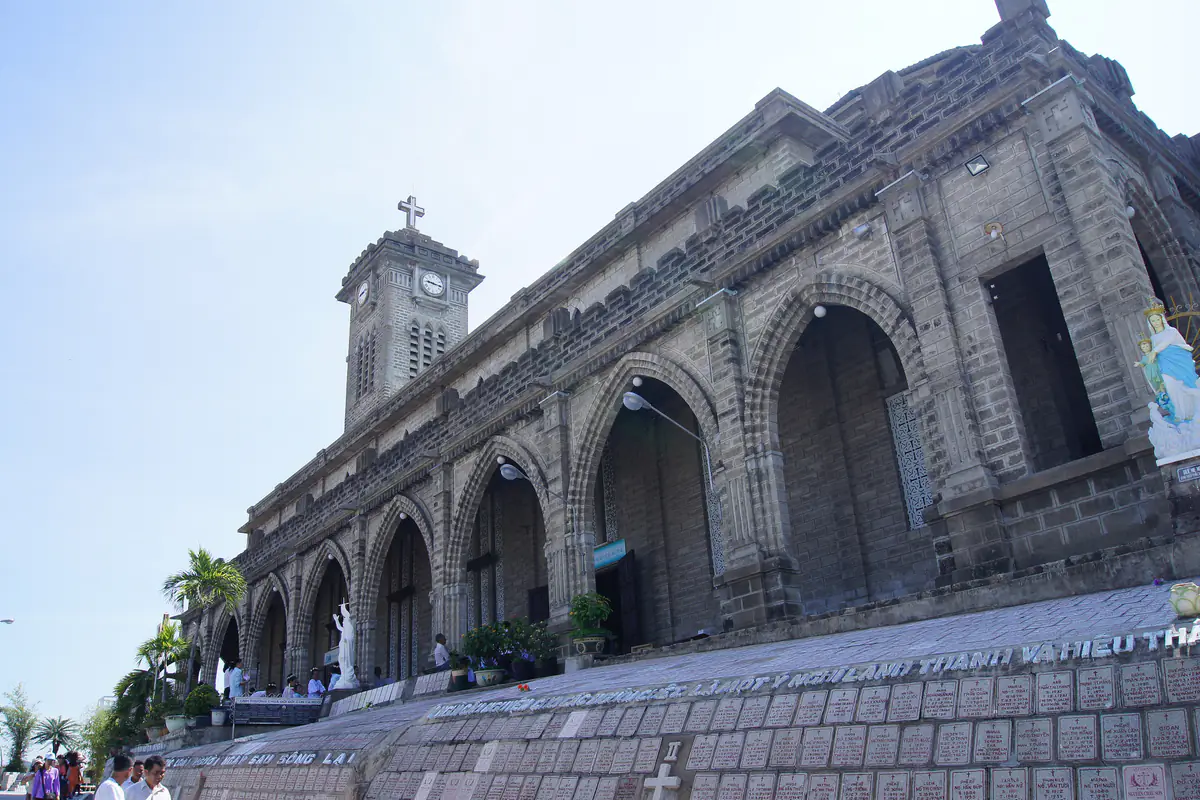
Photo: Hoangvantoanajc
The access road curves around the hillside and leads toward the cathedral grounds.
It avoids much of the staircase, making it a more practical option for some visitors.
However, a sloping road doesn't mean the entire site is wheelchair-accessible. Parts of the courtyard and surrounding paths may still have steps, uneven surfaces, or changes in elevation.
Wheelchair users should ask the cathedral staff which areas can be reached safely before proceeding.
The road is also used by people attending religious services. During Mass times, there may be more pedestrians and vehicles than usual.
Avoid stopping in the middle of the access road for photos, particularly where vehicles need space to pass.
Walking from the railway station
Short walk
Nha Trang Railway Station is on Thai Nguyen Street, a short walk from the cathedral.
From the station, head toward the Nga Sau intersection and look for the cathedral entrance or the route leading up the hill.
This makes Nha Trang Cathedral a convenient stop if your train arrives in the morning and you have time before checking into your hotel.
However, it's better to leave large suitcases at your accommodation or another suitable luggage storage facility.
Dragging heavy luggage up the stone staircase is inconvenient, and the cathedral courtyard isn't a luggage storage area.
Always follow the pavement and designated street crossings. Don't attempt shortcuts across the railway tracks.
Getting there from Tran Phu Beach
About 1.5-2 km
From the central beachfront area along Tran Phu Street, Nha Trang Cathedral is approximately 1.5-2 km away, depending on your starting point.
You can walk if the weather is comfortable, or take a taxi or ride-hailing vehicle if you're traveling with young children.
Motorbikes go in an authorized parking area, following the instructions at the entrance; you can't ride directly into the courtyard.
Car parking around the foot of the hill and Nga Sau intersection may be limited, especially when people are arriving for Mass.
Your driver may drop you off below the cathedral, so identify the entrance before getting out.
Nha Trang Cathedral opening hours
Opening hours are the most confusing part of planning a visit, because the hours when the grounds are open are not the hours when tourists can enter the church interior.
The grounds are open roughly 5:30 AM-5:00 PM on weekdays. The interior is easiest to see between 8:00-11:15 AM and 2:00-4:15 PM. Aim to arrive 8:30-10:30 AM or 2:00-3:45 PM on weekdays.
| Day | Grounds open |
|---|---|
| Weekdays | 5:30 AM-5:00 PM |
| Sunday | 5:00-7:00 AM and 11:00 AM-4:30 PM |
The church doors can still be closed to visitors within these windows.
Arriving close to 11:15 AM could leave you with only enough time to explore the outside. Coming after 4:00 PM may also be less convenient because the cathedral is preparing for the 5:00 PM Mass.
Sundays are more complicated, with several services and other religious activities throughout the day.
For architecture and photography, choose a weekday.
Why might the cathedral be closed during opening hours?
Christ the King Cathedral is a working Catholic church with no fixed visitor route.
Alongside regular Masses, it hosts weddings, funerals, diocesan ceremonies, and other religious activities.
Sometimes the outer gates may be open while the main church is closed to sightseeing visitors. At other times, staff may need to prepare the interior before Mass or organize activities that require privacy.
A listing marked "Open" on a map doesn't necessarily mean you're allowed to enter the sanctuary.
On a tightly planned day, leave a little slack around the visit.
Free admission doesn't mean unrestricted access.
Nha Trang Cathedral Mass times
Christ the King Cathedral normally holds two weekday Masses and five Sunday Masses.
| Day | Mass times |
|---|---|
| Monday-Saturday | 4:45 AM and 5:00 PM |
| Sunday morning | 5:00 AM, 7:00 AM, 9:30 AM |
| Sunday afternoon and evening | 4:30 PM, 6:30 PM |
| Sunday Eucharistic Adoration | 3:00 PM |
The 5:00 PM Saturday evening Mass follows the Sunday liturgy.
Mass schedules may change during Christmas, Holy Week, Easter, major Catholic feast days, and special diocesan events.
Treat these as the regular schedules and check parish announcements for specific holidays.
Which times should sightseeing visitors avoid?
On weekdays, the main times to keep in mind are early morning and around 5:00 PM.
The 4:45 AM Mass is unlikely to affect most tourists because it's so early.
The 5:00 PM Mass is more relevant, especially if you're planning to take late-afternoon photos.
Between approximately 4:15 PM and 5:15 PM, avoid walking around the interior, posing in the main doorway, or recording videos near worshippers.
Sundays have more services, so periods around 7:00 AM, 9:30 AM, 3:00 PM, 4:30 PM, and 6:30 PM deserve particular attention.
Even between services, church staff may be preparing the space for the next congregation.
For visitors who want to examine the stained-glass windows, arches, and interior details, a weekday around 8:30 AM or 2:30 PM is generally the easier choice.
What if you want to attend Mass?
Arrive about 10-15 minutes before the scheduled start.
That gives you time to find a seat, silence your phone, and settle in without interrupting the service.
For Sunday visitors, the 7:00 AM and 9:30 AM Masses are convenient if you prefer the morning.
The 6:30 PM Mass works better if you want to spend the daytime exploring Nha Trang.
For an important feast day or any specific service, check the parish's latest announcement before traveling.
Can non-Catholic tourists enter Nha Trang Cathedral?
Yes. Non-Catholic visitors, including international tourists, can visit Nha Trang Cathedral when the relevant areas are open and visitors are permitted.
Anyone can admire the exterior, walk through designated parts of the grounds, or sit quietly inside when access is allowed.
However, visiting a church for sightseeing and participating in a religious service are different activities.
The cathedral may restrict sightseeing access whenever a service or other religious event requires a quieter environment.
Visiting when there is no Mass
Most tourists should aim for this time.
With the main doors open and no signs restricting access, you may enter quietly.
Before walking farther inside, take a moment to see whether anyone is praying.
Choose a place where you won't interrupt them.
Don't walk toward the altar just because the front of the church looks empty.
The sanctuary is reserved for liturgical activities and people with responsibilities there.
Similarly, don't enter side rooms, parish offices, private areas, or stairways leading toward the bell tower without permission.
Visiting during Mass
Non-Catholics may observe Mass when entry is permitted and suitable seating is available.
This can be a meaningful way to understand the religious life of the local community, but it isn't a tourist performance.
Sit quietly, preferably toward the back.
Nobody expects you to copy every gesture or response. You can observe respectfully as the congregation stands, sits, and prays.
One important distinction concerns Holy Communion.
Visitors who are not eligible to receive Communion under Catholic rules should not join the Communion line simply to experience the ritual.
During Mass, don't move between pews looking for camera angles, photograph people praying, or use flash.
Arriving mid-service just for sightseeing photos? Remain outside or come back later.
Visiting during weddings, funerals, or private ceremonies
Family ceremonies can bring many people to the cathedral, but a busy church isn't necessarily an open invitation for tourists to take photographs.
Avoid blocking the entrance when a wedding or funeral procession is arriving.
Don't take close-up photographs of the couple, grieving families, or other participants without permission.
For private ceremonies, follow the signs and instructions from the parish.
Leave the area to those involved in the event.
Is there an entrance fee for Nha Trang Cathedral?
Nha Trang Cathedral admission in 2026 is free: VND 0.
There is no standard sightseeing ticket for Vietnamese or international visitors.
You can enter the grounds and see the architecture in public areas without a ticket.
Voluntary religious donations are different from admission fees. A visit doesn't oblige you to donate.
Separate activities, such as wedding photography, commercial filming, or organized productions within the grounds, should be discussed with the parish beforehand.
Free sightseeing access doesn't automatically provide permission to use the cathedral as a commercial filming location.
You may still incur personal expenses for transport or parking. These are separate from cathedral admission, and any applicable charges should be confirmed with the service provider.
When was Nha Trang Cathedral built?
Construction of Nha Trang Cathedral began on September 3, 1928, and the church was inaugurated on March 14, 1933.
The project was closely associated with French priest Father Louis Vallet.
Before the present cathedral was built, the Catholic community in Nha Trang worshipped in smaller chapels.
As the community grew and Nha Trang developed, a larger church became necessary.
Father Louis Vallet, who had previously served the Catholic community in Cho Moi, played a major role in establishing the new church on the rocky hill near the town center.
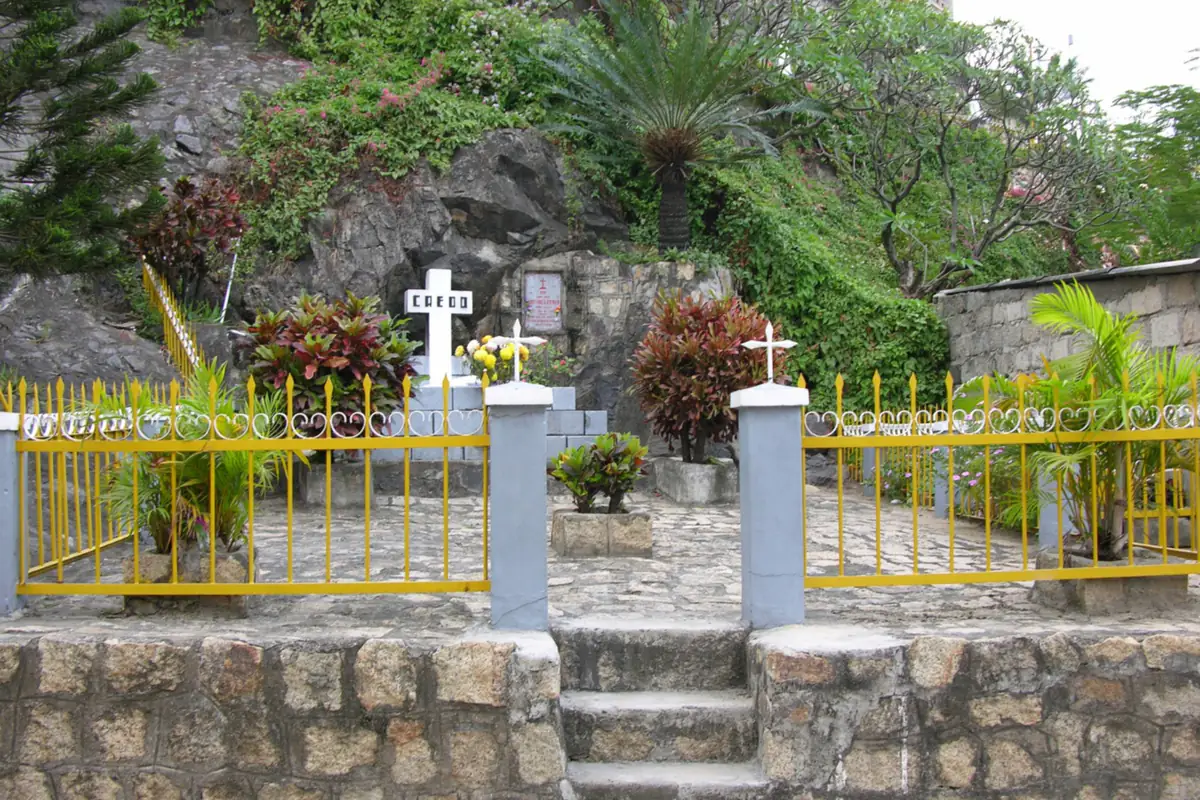
Photo: Vinhtantran
The building was completed in 1933 and became an important place of worship for local Catholics.
The Diocese of Nha Trang was established on July 5, 1957.
On November 24, 1960, the church formally took on its role as the cathedral of the diocese.
The word "cathedral" has a specific meaning in the Catholic Church. It refers to the church containing the bishop's cathedra, or official chair, representing his teaching and pastoral authority.
So Nha Trang Cathedral is more than a historic landmark. It remains a central religious institution for the Catholic Diocese of Nha Trang.
Why is it called Mountain Church?
The Vietnamese name Nhà thờ Núi means Mountain Church.
It refers to the cathedral's position on a small rocky hill, often identified in historical descriptions as Nui Bong or Hoang Lan Hill.
The hill rises approximately 12 meters above the surrounding neighborhood.
That elevation is enough to make the cathedral noticeable from nearby streets, especially around the Nga Sau intersection.
The alternative name Nhà thờ Đá, or Stone Church, comes from its gray stone exterior.
The rough stone surfaces give the building a solid appearance that differs from many brightly painted churches in Vietnam.
However, the name doesn't mean the entire structure is made exclusively of natural stone.
The building uses reinforced concrete combined with split stone, producing the distinctive stone appearance seen today.
What is worth seeing inside Nha Trang Stone Church?
Nha Trang Cathedral has Gothic-inspired architecture, with features associated with European church design.
Pointed arches, tall windows, vertical lines, and the high clock tower give the building its recognizable appearance.
For a short visit, concentrate on a few details and move from the exterior toward the interior where entry is allowed.
Stone facade and clock tower
About 38 m tall
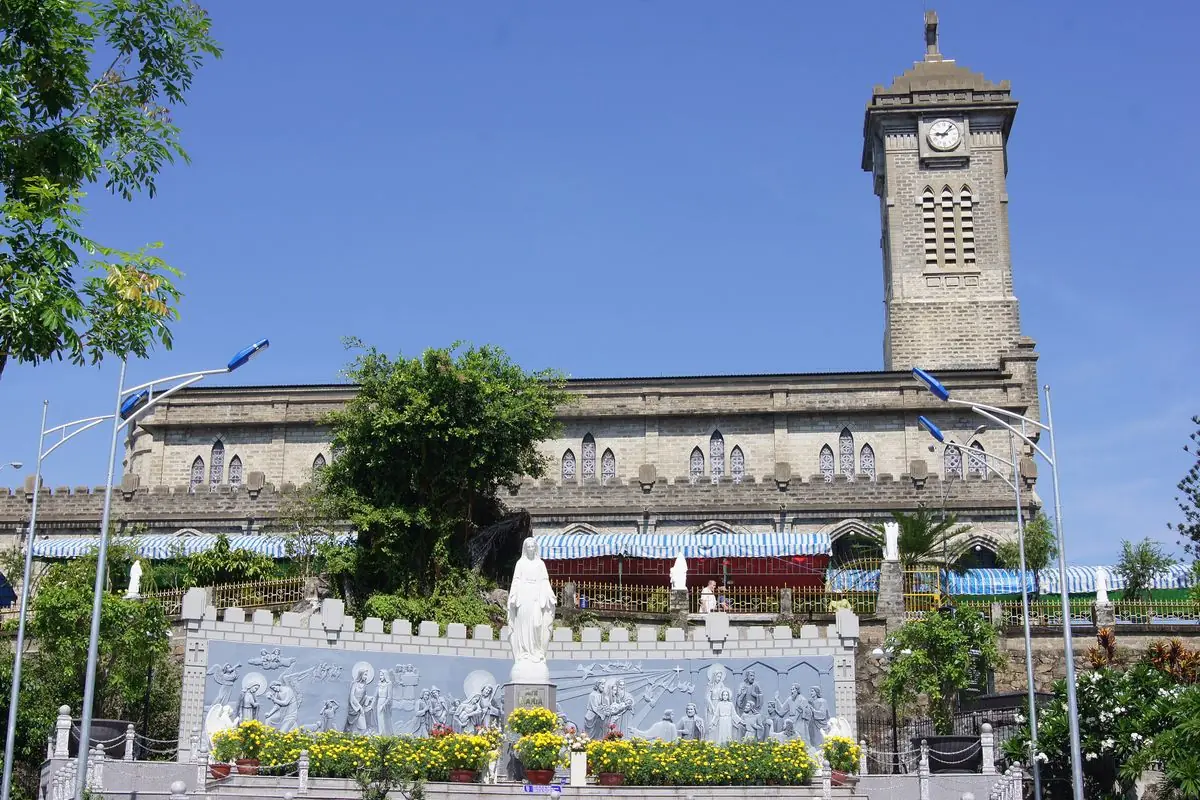
Photo: Hoangvantoanajc
From the front courtyard, the façade looks relatively balanced, with the main entrance in the center, tall windows above, and a tower rising over the church.
A cross stands at the top.
The tower reaches approximately 38 meters above street level, with clock faces visible from different directions around Nga Sau.
The pointed arches, stone moldings, and supporting elements add depth to the façade.
Standing too close to the wall makes it difficult to see the building's proportions.
Instead, move back toward the open courtyard, find a position that doesn't block pedestrian traffic, and look upward.
A photograph showing the complete façade gives a better impression of the relationship between the tower, windows, and main church than a close-up of the wooden doors alone.
Stained-glass windows
Best with some sun
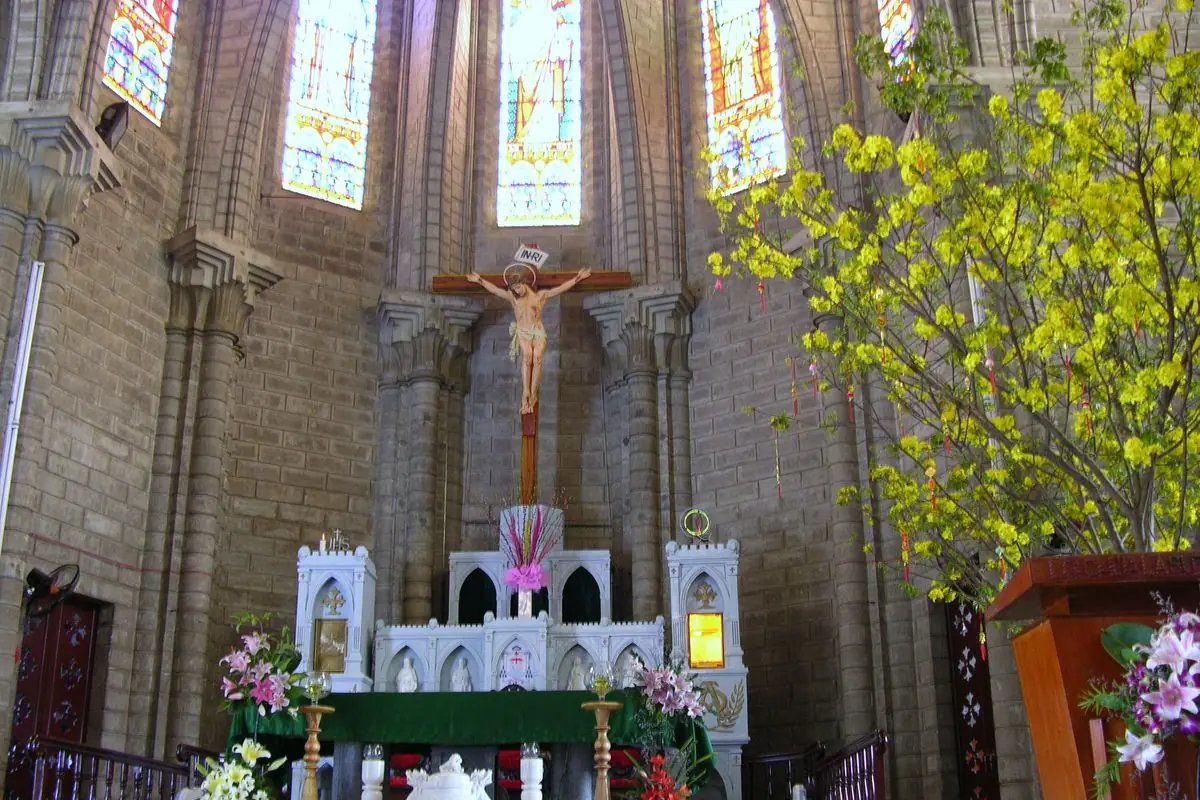
Photo: Vinhtantran
The stained-glass windows are among the most interesting features of the interior.
Natural light passes through the colored glass, creating patches of color across the walls and inside the church.
The effect changes with the weather and the angle of the sun.
A sunny afternoon can be particularly interesting, although the light won't fall through every window in the same way at the same time.
When you enter the cathedral, allow your eyes to adjust to the darker interior.
Look up at the windows before reaching for your phone.
Avoid using flash to brighten the space. It may disturb people praying, and the artificial light won't capture the stained glass as naturally as daylight.
Vaulted ceiling and main nave
View from the back or sides
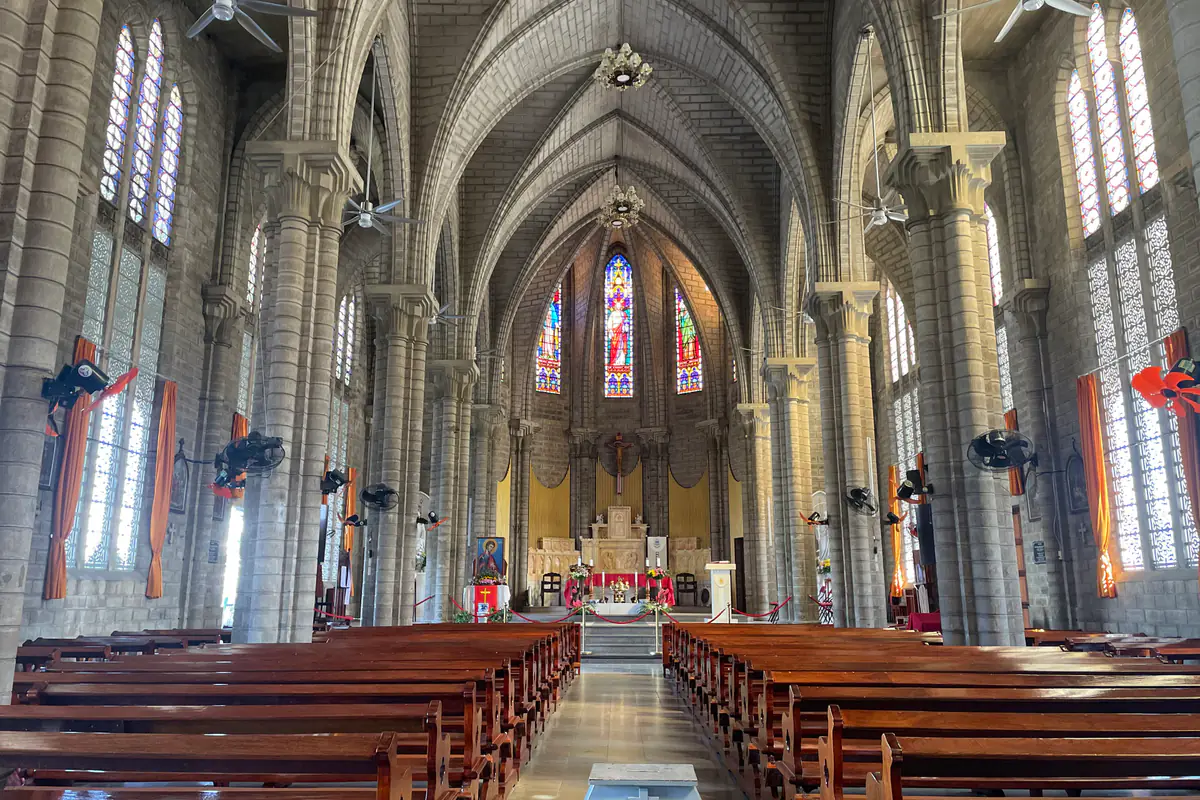
Photo: Baoothersks
Inside, the church follows a long central axis, with rows of pews facing the altar.
The high vaulted ceiling draws your eyes upward and makes the space feel larger.
When sightseeing access is allowed, you can appreciate most of the architectural structure from the rear or permitted side areas.
There's no need to walk all the way to the front.
Avoid crossing in front of people who are praying or constantly changing positions to take photographs. A shot that would interrupt a ceremony is one to skip.
Statues and memorial niches
Look, don't touch
The cathedral grounds also contain religious statues and memorial features, including representations associated with Jesus Christ and Catholic saints.
Some stone walls have niches containing the remains of deceased people.
These are places of remembrance.
You may look at them from permitted paths, but don't touch the memorials, lean against them, sit on them, or pose in front of burial niches.
Families with children should explain this before entering the area.
The courtyard overlooking Nga Sau
Side walls and arches
From the cathedral courtyard, you can see part of the neighborhood and the traffic moving through the Nga Sau intersection below.
The contrast between the old religious building and the busy modern streets makes this viewpoint interesting.
It's also a useful place to examine the side walls, pointed openings, and stonework without entering the church.
On clear days, sunlight emphasizes the texture and lines of the stone.
Cloudy weather can be good for photography too, because the walls are less likely to have harsh areas of brightness and shadow.
The courtyard isn't large enough to occupy an entire afternoon.
After you've examined the façade, arches, and accessible parts of the grounds, you've already seen most of the cathedral's main architectural features.
How to take good photos at Nha Trang Cathedral respectfully
There are plenty of attractive angles at Nha Trang Stone Church, but choosing the right position matters more than having expensive camera equipment.
Photograph the entire façade
The simplest composition is from the front courtyard.
Move far enough back to include both the clock tower and main entrance.
Keep your camera level rather than tilting it sharply upward.
A very wide lens can make the walls appear to lean inward, particularly when you're standing close to the building.
On a smartphone, the standard camera often gives more natural proportions than the ultra-wide setting.
For a portrait, stand slightly off-center so your body doesn't completely cover the entrance or tower.
Don't occupy the main doorway for too long, especially when worshippers are arriving.
Focus on the arches and stone details
Once you have a wider photograph, look for smaller architectural details.
The pointed doorframes, stone joints, and decorative elements work well for close-up images.
These are useful alternatives when the courtyard is crowded and getting a clean full-building photograph is difficult.
Most details can be photographed from a reasonable distance, without standing against a closed door or sitting on the church steps.
Can you take pictures inside?
Only take photographs when the cathedral allows them and no religious service is being disturbed.
Don't use flash, set up a tripod that blocks an aisle, or photograph people praying without their consent.
If you see a no-photography sign, follow it.
Wedding shoots, advertising photography, professional filming, and larger production teams should seek permission from the parish beforehand.
The fact that other tourists are taking casual photos doesn't mean every form of photography is authorized.
Is morning or afternoon better for photography?
Morning, around 8:00-10:00 AM, works well if you want cooler conditions and enough time for other activities afterward.
Early afternoon, around 2:00-3:45 PM, can be useful for observing light through the stained-glass windows when the weather is clear.
There isn't one exact hour that guarantees perfect photographs.
The sun's position and cloud cover change throughout the year, so prioritize an appropriate visiting window over chasing a particular lighting effect.
What to wear and how to behave at Nha Trang Cathedral
Nha Trang Cathedral is a place of worship, so beachwear isn't a good choice for visiting the interior.
Wear a top that covers your shoulders, along with long trousers or a skirt that reaches at least around the knee.
Comfortable shoes are helpful because of the stone steps and sloping paths.
Formal dress isn't expected. Avoid very short shorts, revealing tops, transparent clothing, or outfits designed primarily for the beach.
Coming straight from swimming? Change into dry clothes before visiting.
A light shirt or scarf can help cover your shoulders, but a beach towel or wet swimwear isn't appropriate inside the church.
Remove your hat when entering the sanctuary, put away sunglasses when appropriate, and switch your phone to silent mode.
Don't eat or drink inside the main church.
Children are welcome when access is allowed, but adults should keep them close and prevent them from running between the pews.
Groups should save longer conversations for outside the church.
Avoid calling loudly to friends from one end of the building to the other.
These expectations apply to international visitors as well.
Not speaking Vietnamese or not being Catholic doesn't prevent you from visiting. Respect the religious purpose of the space and follow instructions from the people responsible for it.
How much time do you need at Nha Trang Cathedral?
About 30-45 minutes is enough for most visitors.
This isn't a museum with numerous exhibition rooms or a long walking route.
The main attractions are concentrated around the courtyard, stone façade, clock tower, and church interior when it is open.
Here's a practical example of a short morning visit:
- 8:30-8:40 AM
Arrive
Check entrance notices and walk up the hill.
- 8:40-8:50 AM
Facade and tower
Look at the facade and clock tower, then take photos.
- 8:50-9:05 AM
Interior
See the interior and stained glass if entry is permitted.
- 9:05-9:15 AM
Courtyard
Walk around the accessible parts of the courtyard and leave.
This is a suggested plan for independent visitors.
With the church interior closed, concentrate on the exterior and finish earlier. Don't wait indefinitely when you don't know whether the building will reopen.
Travelers interested in architectural photography or religious history may prefer 45-60 minutes.
Families with small children should allow additional time for walking up and down the hill.
To attend a complete Mass, set aside a separate period for the service rather than including it in the standard sightseeing allowance.
Don't schedule your visit immediately before a train departure, hotel transfer, or restaurant reservation.
The cathedral itself doesn't take long to see, but access depends on the parish's activities on the day.
Is it better to visit on a weekday or Sunday?
If you want to see the architecture and take photographs, a weekday is the better choice.
Sunday includes several Masses and Eucharistic Adoration, leaving fewer straightforward sightseeing opportunities.
Weekdays are also easier to combine with other attractions in central Nha Trang.
You could visit the cathedral around 8:30 AM, then continue to Long Son Pagoda to see another important religious landmark.
Long Son Pagoda is located near 23 Thang 10 Street, a relatively short journey from the cathedral.
The two sites have different architectural traditions and religious purposes, making them an interesting combination for a morning in the city.
Visiting straight after arriving by train
Arriving at Nha Trang Railway Station? Check your train's scheduled arrival time before deciding whether to visit immediately.
A midday arrival isn't always ideal because the cathedral interior may be closed during the lunch period.
Leave any luggage somewhere suitable before climbing the hill.
The station's proximity makes the cathedral convenient, but that doesn't mean it's always open when your train arrives.
What about visiting on Sunday?
Sunday is suitable if your main purpose is attending Mass or observing the cathedral's religious life respectfully.
For sightseeing alone, it's less predictable.
Even when the grounds are accessible, some parts of the interior may be unavailable because of services or preparations.
Don't assume Sunday sightseeing hours are identical to weekday hours.
Does the rainy season affect visiting?
Nha Trang's wetter season generally falls in the later months of the year, particularly around October to December.
During heavy rain, the stone steps and sloping access paths can become wet and less comfortable to use.
This is an urban landmark rather than a hiking destination, so specialist outdoor equipment is unnecessary.
However, shoes with good grip are helpful, and you shouldn't rush on wet stairs.
Follow any restrictions or warnings around the grounds.
If heavy rain causes local flooding or authorities issue severe weather warnings, postpone the visit.
A free attraction that can be visited another day isn't worth taking unnecessary risks for.
Hot sunny weather can also make a midday visit uncomfortable. In that case, the morning is more practical, and you can finish sightseeing before lunch.
Common situations visitors encounter
You arrive during opening hours, but the church doors are closed
First, check the entrance notices and see whether any outdoor areas are still available.
With the courtyard open, you can appreciate the stone exterior and take permitted photographs from outside.
Don't search for a rear entrance to get into the sanctuary.
Ask a staff member when it reopens rather than waiting without a plan.
If you only have one day in Nha Trang, move on to another attraction and return later if your schedule allows.
You arrive and find a large crowd of worshippers
A crowd often means a service is about to begin or has just finished.
Make space for people entering and leaving.
Don't stand across the staircase or main entrance.
For a photograph of the façade, wait until the crowd has passed or find a position along the side of the courtyard.
Don't ask people going to church to move out of your photograph.
You're traveling with children or older adults
Choose an entrance that suits the mobility of your group.
Carry drinking water for personal use, bring a hat for sunny outdoor areas, and avoid unnecessary heavy bags.
Explain to children that this is a religious site rather than a playground.
The steps, stone walls, and memorial areas aren't suitable places for running around.
For older travelers with knee problems, a shorter visit focused on the façade may be preferable to trying to explore every part of the grounds.
You need to ask for information in English
English-speaking visitors can use a few short questions when speaking with cathedral staff.
"Is the cathedral open for visitors now?" asks whether sightseeing is currently allowed.
"May I take photos inside?" asks about photography permission.
"What time is the next Mass?" asks when the next religious service begins.
"Where is the entrance?" asks for directions to the access point.
No Catholic terminology is needed: just establish where you're allowed to go and whether photography is permitted, and respect the answer.
Is Nha Trang Cathedral worth adding to your itinerary?
Yes, particularly if you're staying in central Nha Trang, arriving by train, or interested in historic architecture.
The main advantages are its convenient location, free admission, and the relatively short amount of time required.
Unlike an island excursion that depends on boat departures and sea conditions, a cathedral visit is easier to fit into an ordinary morning in the city.
The experience is also different from Nha Trang's beach attractions.
Instead of sand, swimming, or water activities, you'll see a historic religious building that continues to serve its local Catholic community.
However, don't expect a long list of activities for children.
There are no conventional amusement facilities, major shopping areas, or extensive museum galleries designed specifically for tourists.
The cathedral provides attractive European-inspired architectural settings for casual photography, but visitors must respect restrictions on where and when they can take pictures.
Travelers interested in Catholic religious life can learn more by reading about Mass and basic church etiquette before attending.
That approach is better than arriving during a service and walking around the building as though it were a public exhibition.
The cathedral is a reasonable choice for a free 30 minutes between activities in downtown Nha Trang. If that window falls when tourist access is restricted, don't force it into your itinerary.
Weekday architecture or Sunday atmosphere? For sightseeing, go at 8:30 AM on a weekday. To attend Mass, choose a scheduled service, arrive early, and give the ceremony your full attention.
FAQ
Is Nha Trang Cathedral free to enter in 2026?
Yes. General admission to Nha Trang Cathedral is free for both Vietnamese and international visitors. There is no standard sightseeing ticket, and voluntary religious donations are not mandatory entrance fees.
What are the Sunday Mass times at Nha Trang Cathedral?
Sunday Masses are held at 5:00 AM, 7:00 AM, 9:30 AM, 4:30 PM, and 6:30 PM. Eucharistic Adoration takes place at 3:00 PM and is not an additional Mass. The schedule may change on special religious occasions.
Where is Nha Trang Stone Church, and is it near the train station?
Nha Trang Stone Church is on a small hill beside the Nga Sau intersection on Thai Nguyen Street, within a short walk of Nha Trang Railway Station. The Diocese lists the address as 31A Thai Nguyen Street, while many travel maps show 1 Thai Nguyen Street.
When was Nha Trang Cathedral built?
Construction began on September 3, 1928, and the church was inaugurated on March 14, 1933. The project was associated with French priest Father Louis Vallet. The church became the cathedral of the Diocese of Nha Trang in 1960.
Can non-Catholic tourists visit Nha Trang Cathedral?
Yes. Non-Catholic visitors can explore areas open to tourists and may respectfully observe Mass when permitted. Visitors should avoid entering the sanctuary, receiving Holy Communion if they are not eligible under Catholic rules, or taking photographs during worship.
Related posts
Places
Where to go near Nha Trang? 5 easy day trips worth taking
Compare five places near Nha Trang for an easy half-day or full-day escape.
Places
Go to Nha Trang for a Beach Beside the City
Choose Nha Trang when you want beach time with city life close at hand.
Islands & beaches
Why is Tran Phu beach still worth visiting despite the crowds?
Compare Nha Trang's beaches by swimming conditions, crowds, facilities, and travel time.